By Dr. Keswani, MD — Forever Medspa & Wellness Center
The under-eye area is one of the most searched topics in aesthetics, and one of the most misunderstood. Filler there can give a beautiful, natural result in the right person. In the wrong person, or the wrong layer, it can look worse than before. Here’s how I decide, and how I do it when it’s right.
Most of the time, the answer isn’t right under the eye
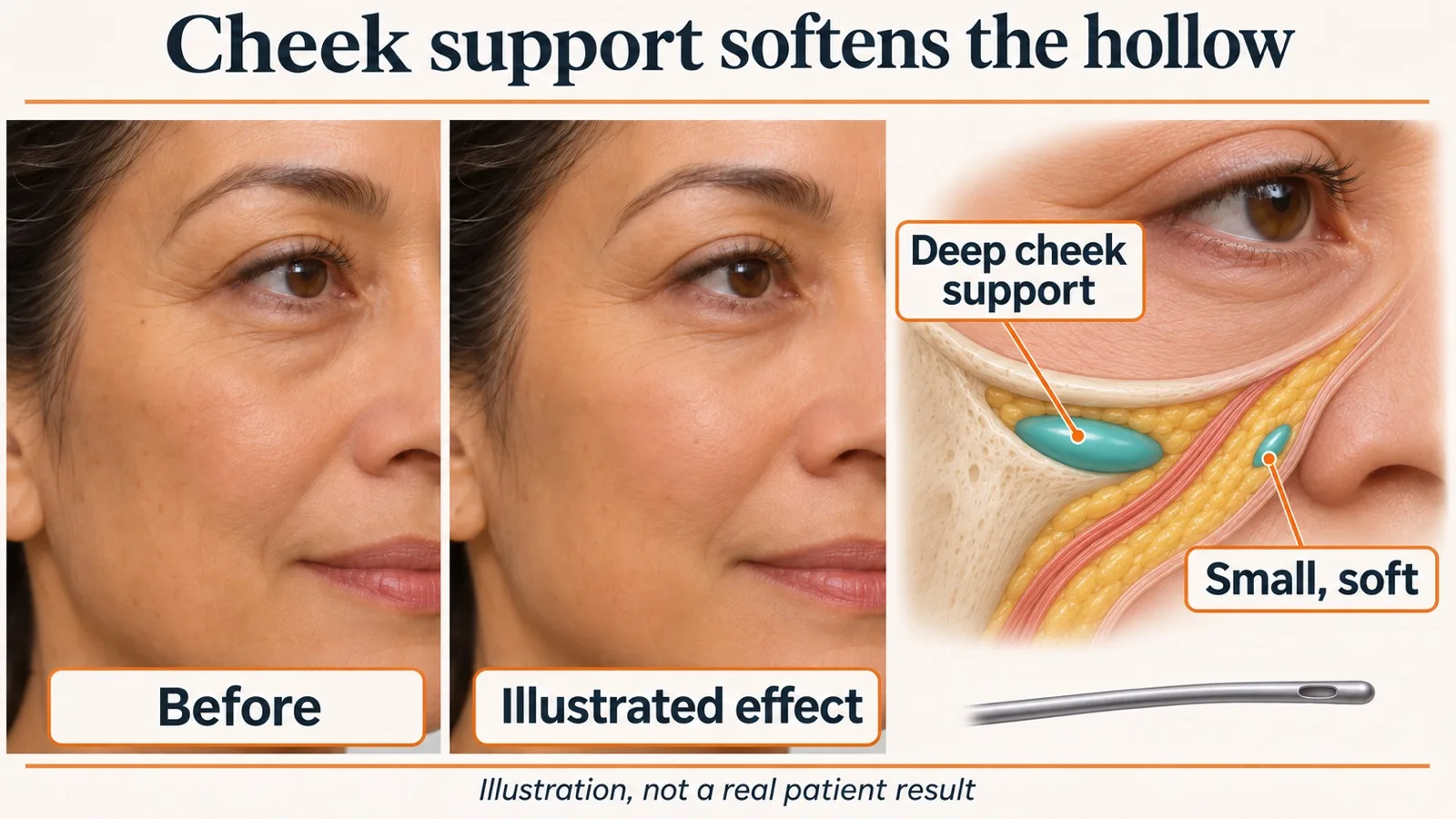
When the cheek falls with age, the lower lid drops with it, and the gap that belonged to the cheek now shows at the eye. So the most helpful filler is often not right under the eye at all. It goes deep in the cheek, on the bone, giving back the support that lets the lower lid sit higher. It also softens the groove that runs down from the tear trough.
For deep support I use firmer fillers: Restylane Lyft, Restylane Defyne, Restylane Contour or Juvéderm Voluma. Sculptra or Radiesse can also build the cheek, but only deep, never superficially.
The press test comes first
Before anything is injected, I gently press the cheek just below the hollow and push upward. If the hollow improves, filler can help, and what you see while it’s pressed is a rough preview of the result. If it’s a crease that doesn’t improve when pressed, it will stay, and filler won’t help it.
Forcing filler into a tight tear trough is how people get poor results. Filler can end up in the eye socket. That isn’t dangerous, but it looks bad: that area tends to collect water and swell, and it’s harder for the dissolving enzyme to reach.
Always a cannula, never a needle
Under the eye, I always use a cannula, a blunt, flexible tube, never a needle. There are big blood vessels deep in this area. A needle there carries a very high risk, and even a bruise can be big.
Less is more
These are small compartments, and how much they need can’t be judged 100% in advance. So I start small. More can always be added; it’s much harder to take away.
Soft areas get soft fillers. For the small hollow beside the nose that shows when you smile, I use a small amount of a soft filler such as Revanesse Versa or Juvéderm Ultra Plus. Very rarely, for a little filler just under the skin, only a very small amount of a soft filler such as Juvéderm Ultra.
How long it lasts
Under the eye, filler generally lasts 9 months to a year.
What can go wrong, honestly
- Swelling. Usually a sign the filler isn’t in the right layer, and then it needs to be dissolved to some extent. The area also has small compartments, so it can swell a little even when the filler is in the right layer; a small amount of dissolving fixes that. And sometimes filler that was fine suddenly swells with something like a viral infection.
- A bluish tint (the Tyndall effect). Filler very close to the surface of thin skin can show a bluish tint. It isn’t harmful. Some people prefer a little tint to seeing crinkling or a hollow, and it can stay; a trained eye may notice it, but most people won’t. If there’s a lot and you don’t like it, it’s dissolved. That’s your choice.
- Bruising. Much lower with a cannula, but the deep vessels mean a bruise here can be big.
Hyaluronic acid filler can be dissolved with an enzyme, hyaluronidase, which is one more reason the right product in the right layer matters.
Who shouldn’t have it
If your bags are fat, filler won’t remove them. The most it can do is soften the gap around them by supporting the cheek. If the hollow doesn’t improve with the press test, filler won’t help. Fillers are for adults only, and we don’t treat with fillers during pregnancy.
Talk it through with us
Under-eye filler is something I do with great care, and only when it fits. Read more on our Eye Area page and our Dermal Fillers page, text us at (201) 340-4809, or book a consultation online. Current offers are on our Promotions page.