
The eyes are one of the first places people notice change — and the under-eye area is one of the most searched topics in aesthetics. It’s also one of the most misunderstood. What looks like a “bag” is often a hollow; what looks like a dark circle can be pigment, thin skin, blood vessels or a shadow; and the cause is often not under the eye at all, but in the cheek, the temple or the forehead around it.
So this page is about awareness, not selling. It explains how the area is built, why each change happens, what genuinely helps — and what doesn’t, including when the honest answer is surgery. Filler under the eye is used only with great care, and only when it fits. Every eye-area plan is made by Dr. Deepak Keswani, MD.
Book a Consultation Text (201) 340-4809
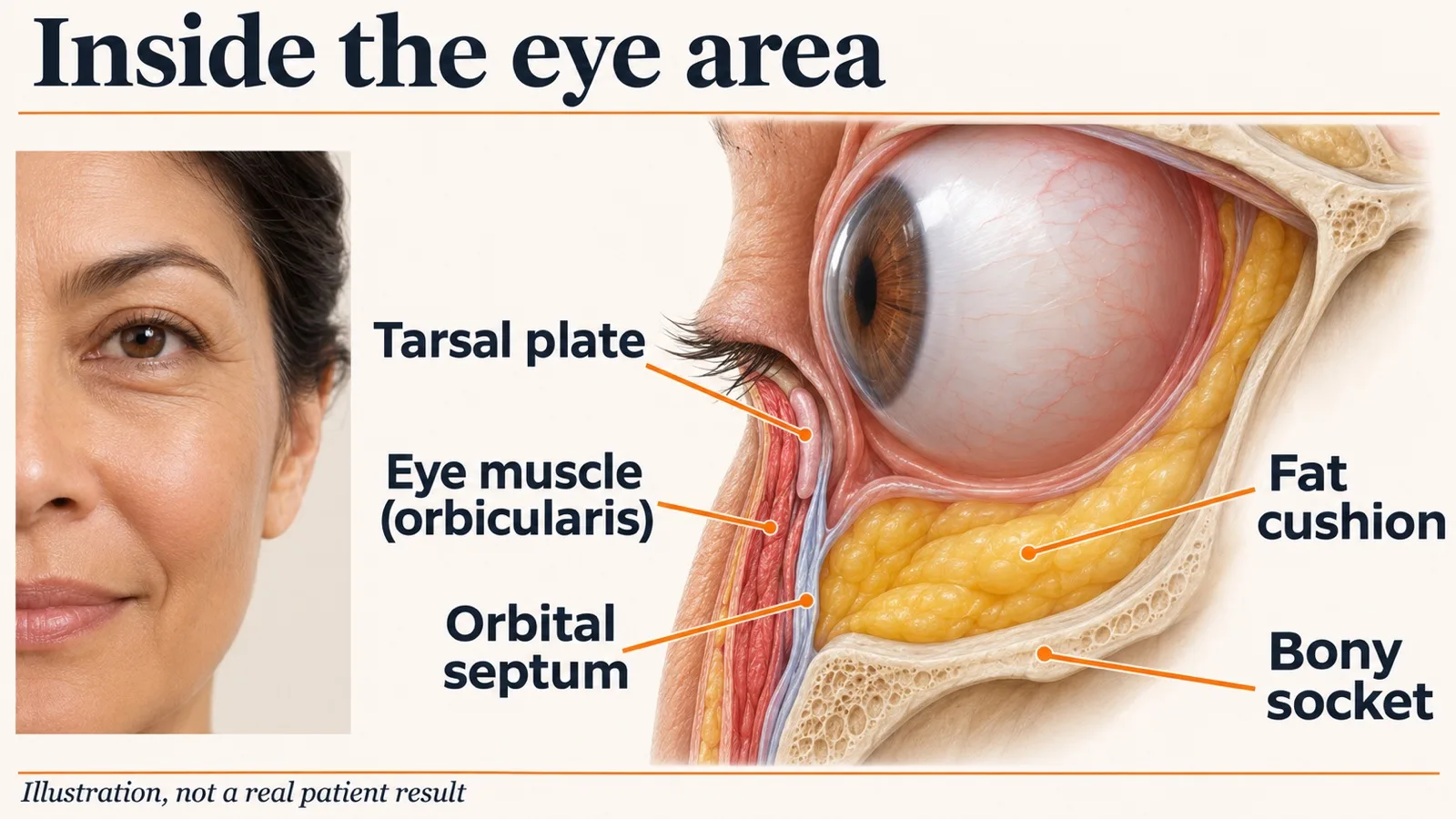
The eyeball sits in a bony socket — a hole in the bones of the face. Small muscles around it move the eye in different directions, and little pockets of fat cushion the eyeball so the muscles don’t rub against it. The eyeball doesn’t fall forward when you look down because a thin sheet, the orbital septum, attaches to the bone around the socket and holds everything back.
In front of the septum is the eye muscle, the orbicularis oculi: its thin palpebral part sits in the lids, and its orbital part runs around the bony rim. Each lid also has a firm part, the tarsal plate. The skin of the lower lid is special: unlike cheek skin, it has no fat under it and no hair follicles; it folds every time you blink; and it sits forward on top of the cheek, where the sun hits it. That’s why it gets thin, crinkly and sun-damaged.
Forehead & skull above
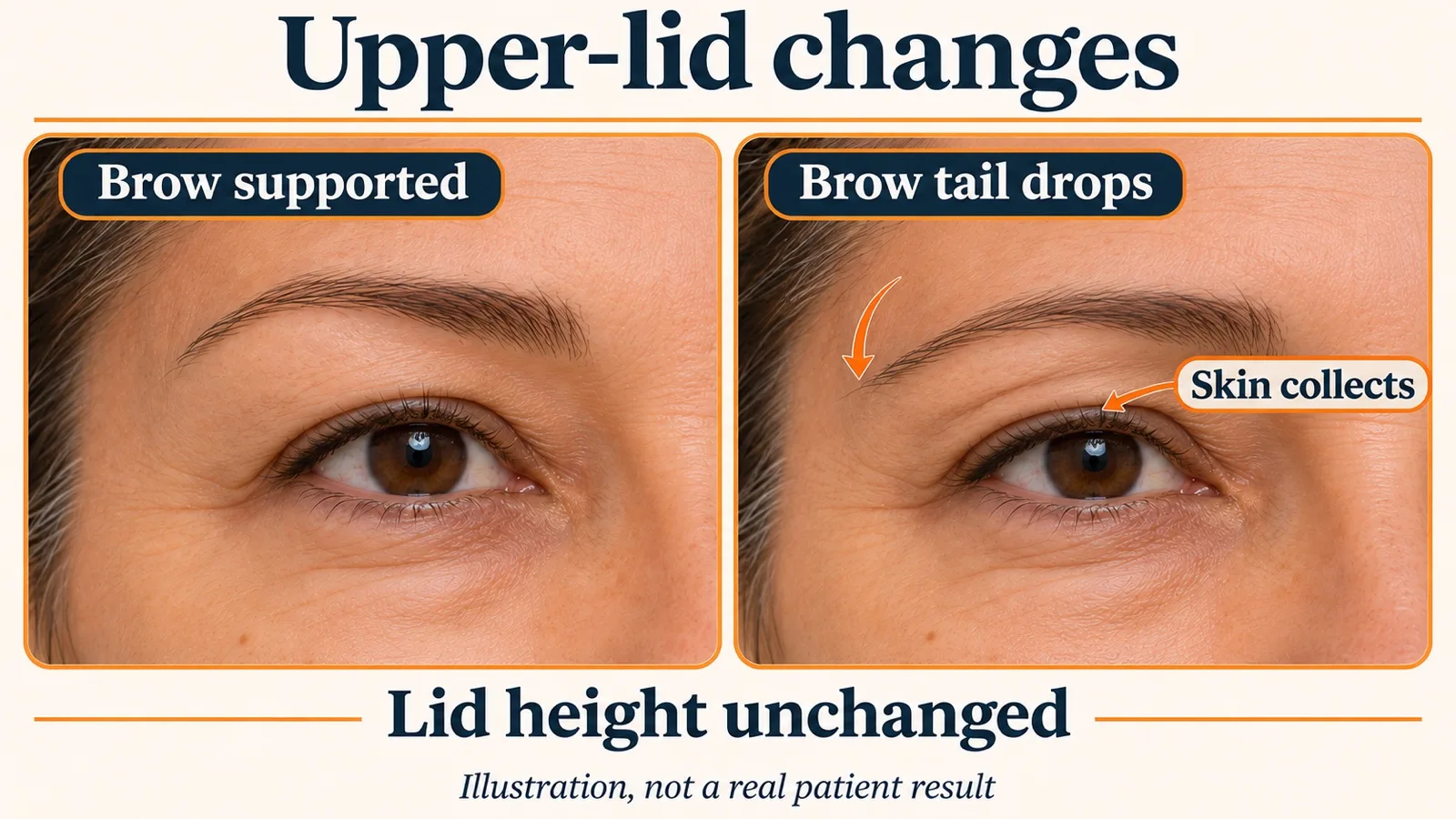
As the forehead, temples and skull lose volume, skin comes down and collects in the upper lid.
Cheek below
When the cheek stops supporting the lower lid, the lid area drops and the gap that belonged to the cheek now shows at the eye.
Temple at the side
Hollow temples make the eye area look bonier. Squeezing the eyes contracts the muscle and creates the lines at the side.
From deep to surface: the bone; the muscles that lift the lip, attached to the bone; the deep fat pads next to the bone that support the cheek (the SOOF, suborbicularis oculi fat); the cheek fat pads above them; a moving layer called the SMAS; and the skin. On the inner side, the eye muscle and septum attach to the bone — that attachment separates the lower lid from the cheek and is the line people see as the tear trough.
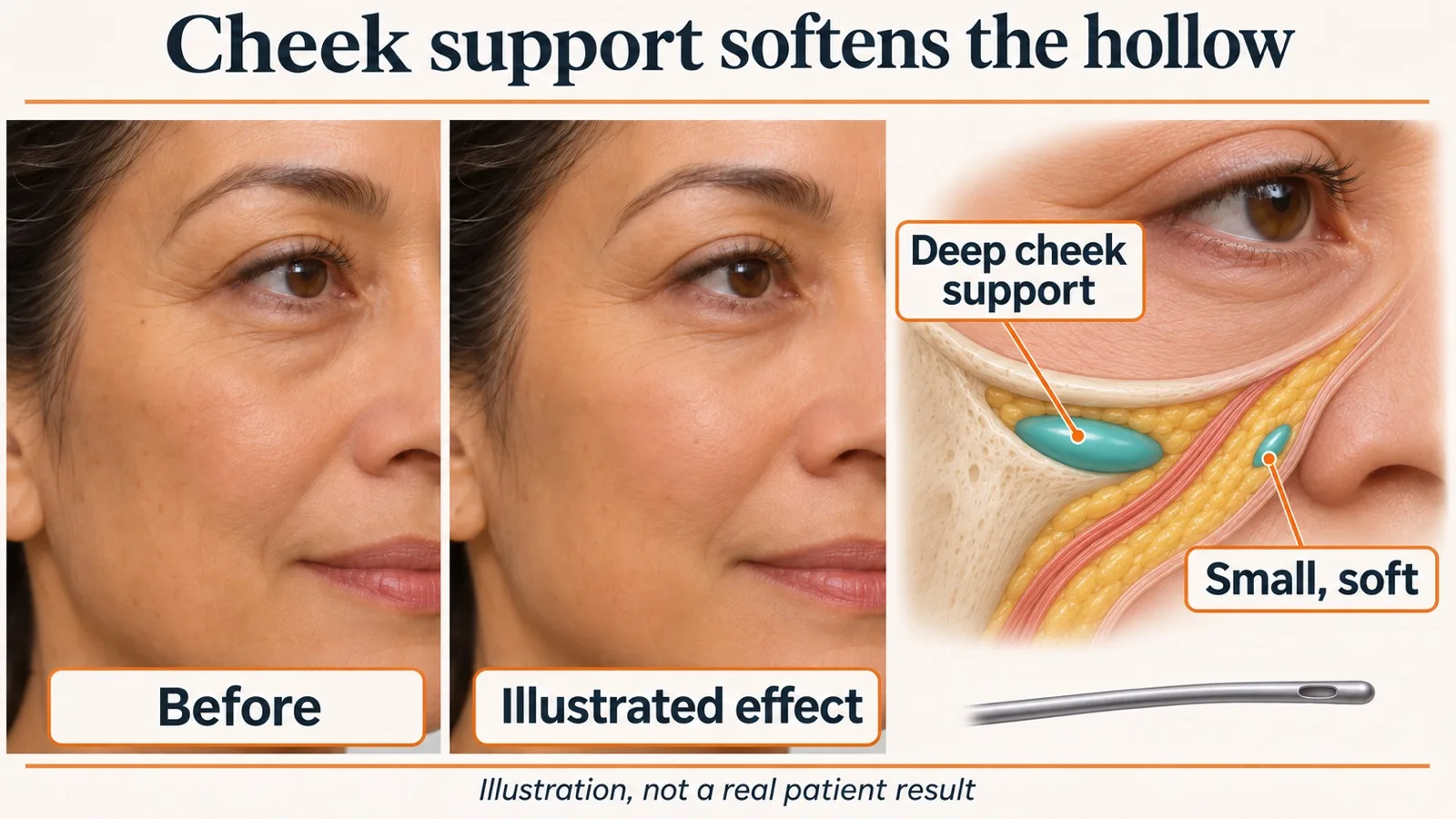
With age, and with repeated weight loss and gain, the deep fat that supports the cheek shrinks — weight lost there isn’t regained in the same place. The cheek falls a little and pulls the lower-lid skin down with it. The gap between the lid and the fallen cheek now looks continuous with the eye, and because the eye area is big and round, people see it as a bag. There’s no bag in it. This is the part filler can actually correct.
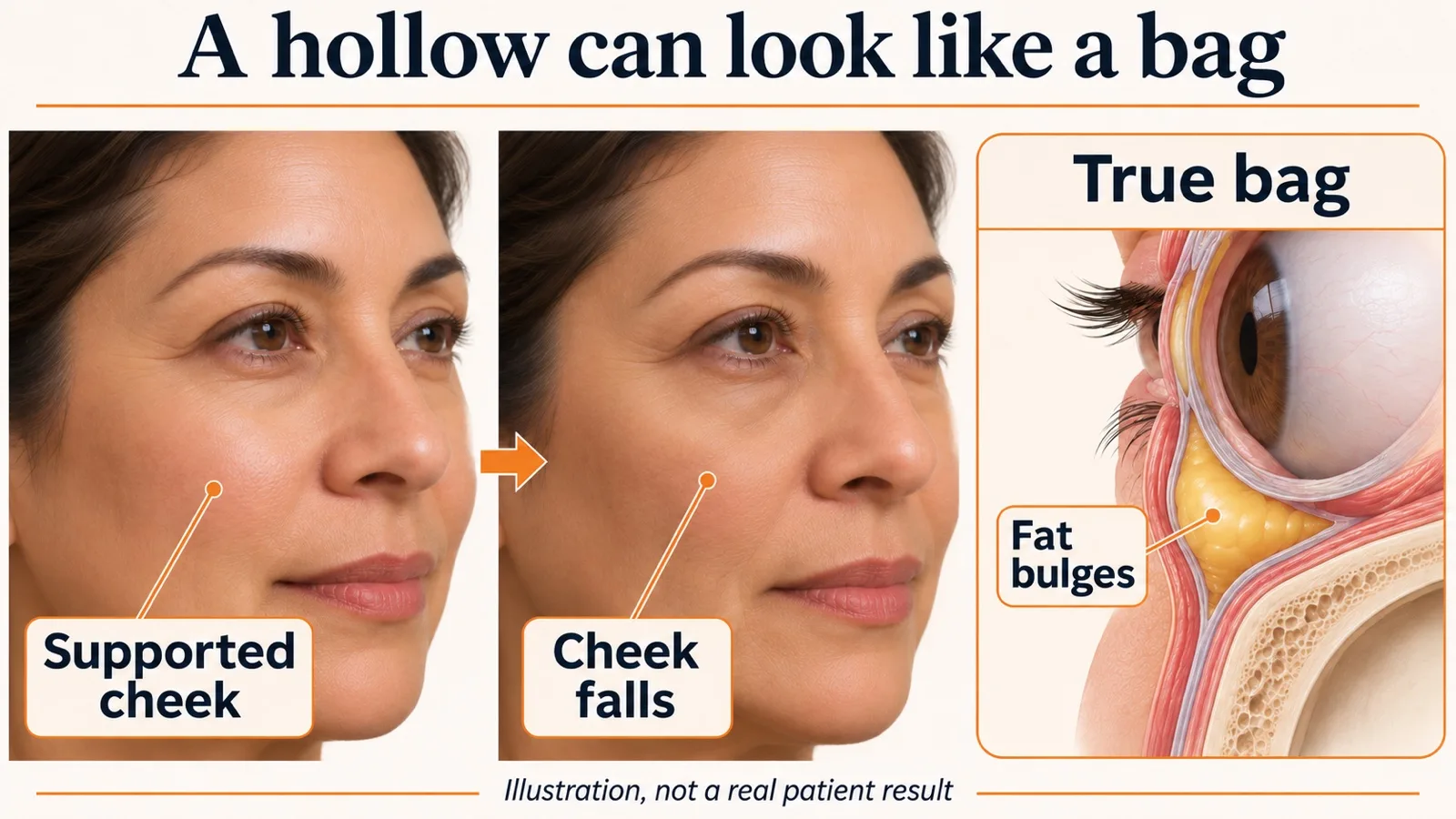
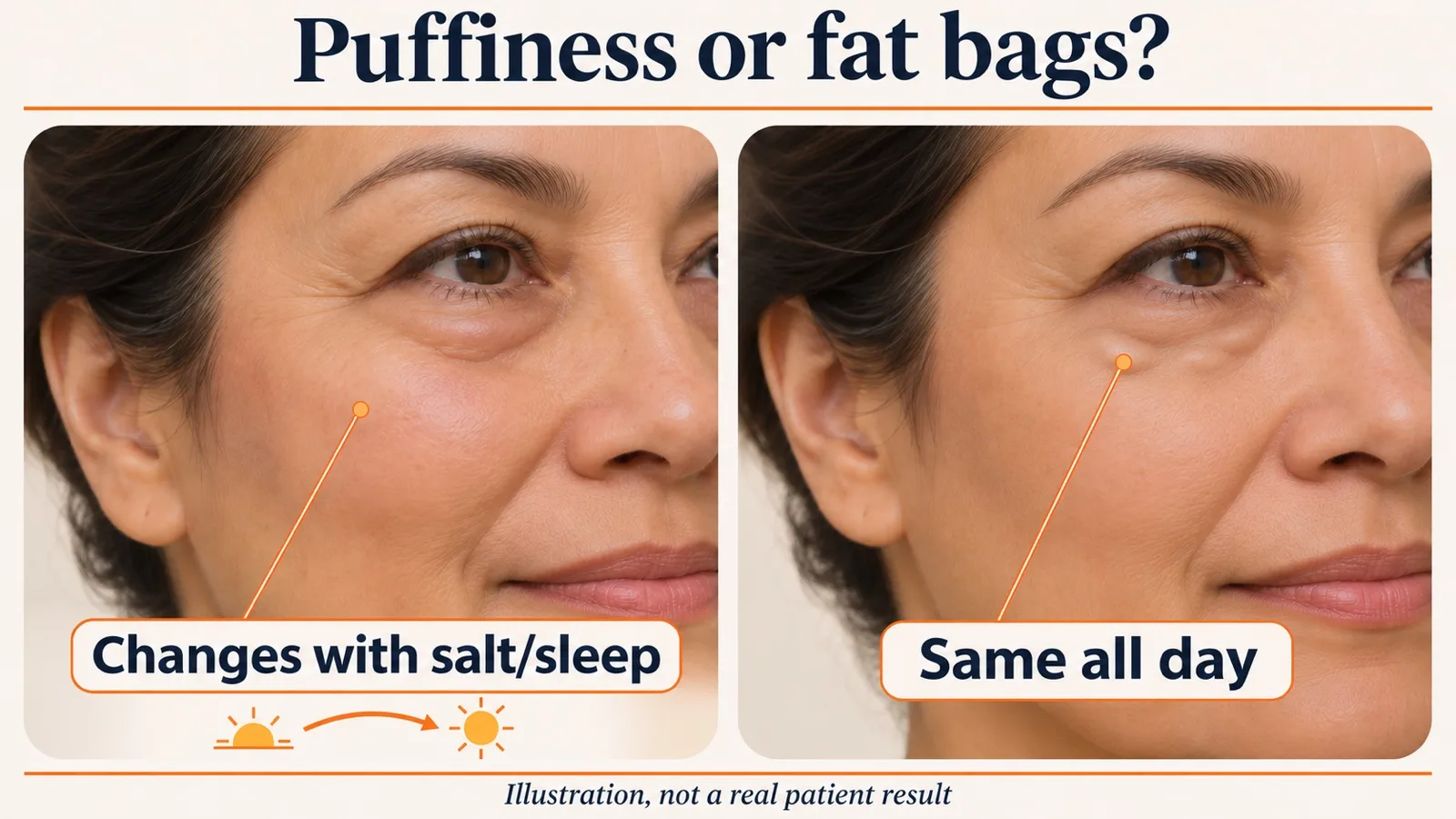
The fat around the eyeball sits behind the septum. The weight of the eyeball pushes it forward, and as the socket gets bigger and the septum and muscle loosen with age, the fat bulges out over the lower edge of the bone — with nothing but that thin septum behind it. Some people have these bulges from a young age, because the socket is a little larger. Fat bags look the same all day and don’t change with salt. In thyroid eye disease (such as Graves’ disease), tissue behind the eye pushes the eyes forward and adds to the bulging.
The area drains slowly, so salt, extra fluids and sleep can mean morning swelling — sometimes in the upper outer cheek just below the outer corner of the eye (malar swelling, or malar mounds). Any medical condition that retains water makes it worse.
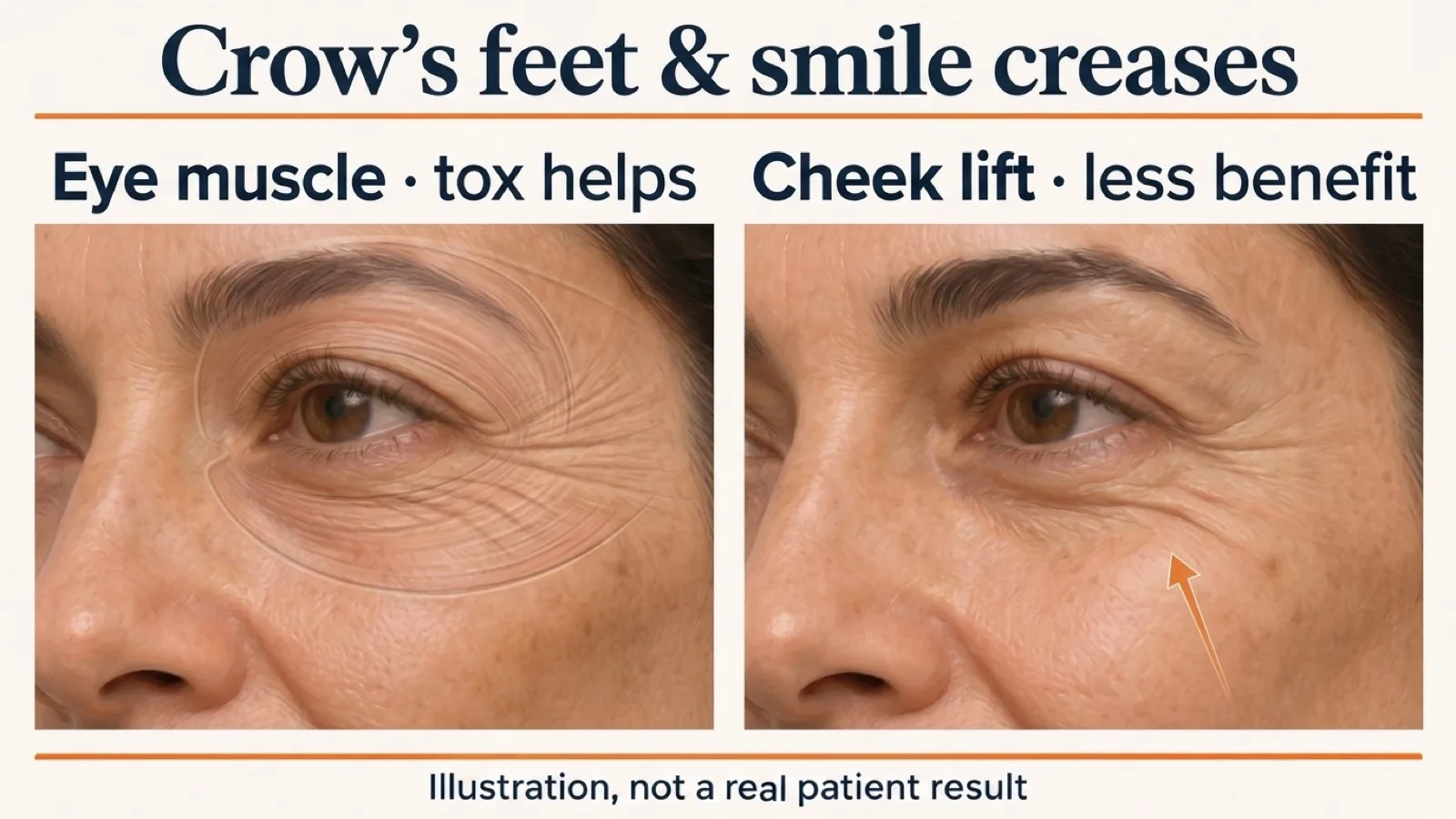
Crow’s feet at the side come from the eye muscle squeezing. The creases just below the outer corner when you smile are different: they come from the cheek moving up, so they’re less about the eye muscle. On the side of the upper nose, inner to the eye corner, are the bunny lines. And a small depression can show beside the nose, under the lower lid, when you smile — from a little less fat in the middle layer of the cheek plus muscle movement.
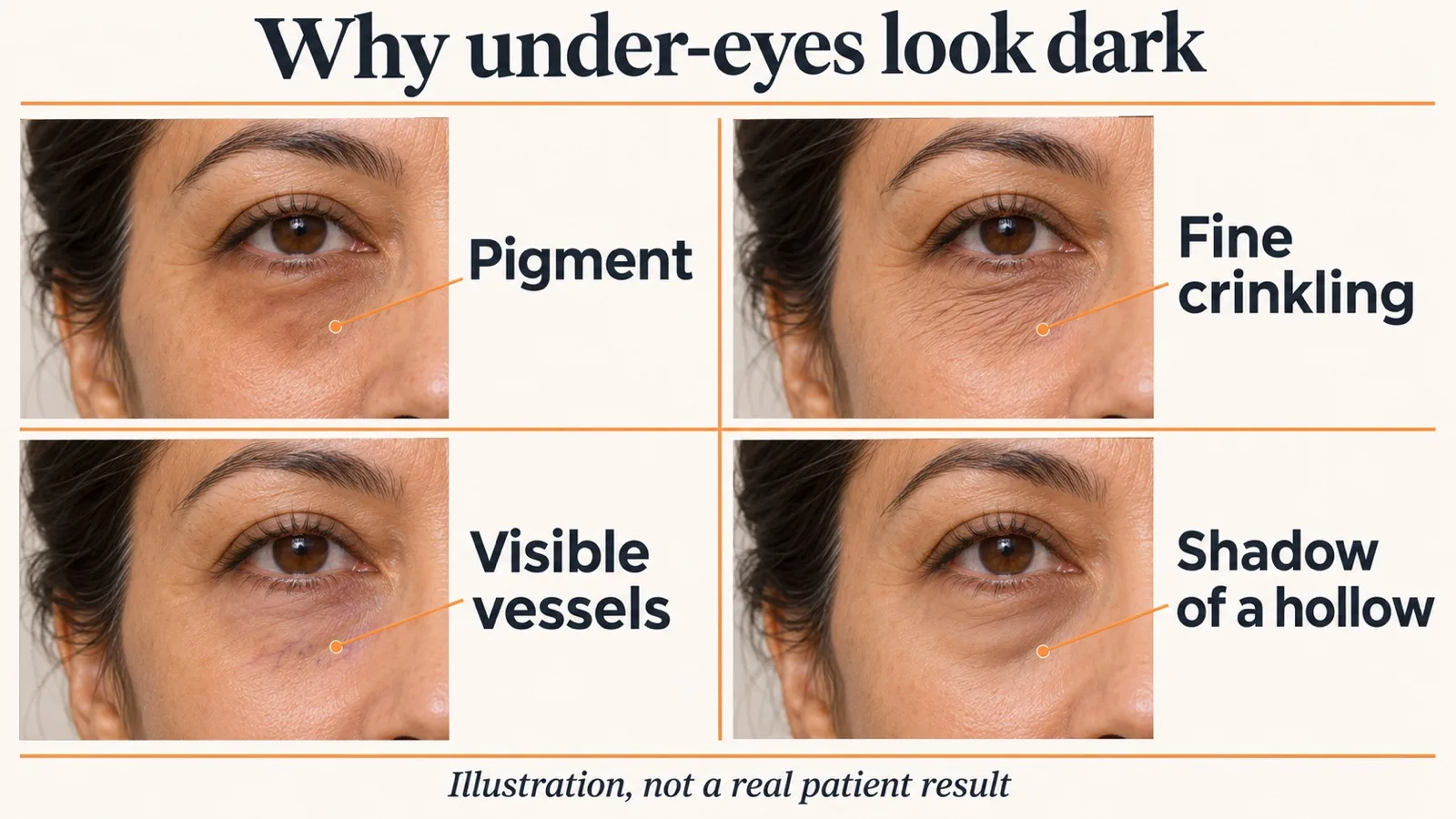
Pigment from the constant small injury of blinking, fine crinkling that makes skin look darker, blood vessels showing through thin skin, and the shadow of a hollow — often several at once.
Volume loss in the forehead, temples and skull lets skin come down and collect in the upper lid, and constant opening and closing — sometimes several times a second — thins that skin further. It can also show sun damage.
Honest answers, including what doesn’t work. Each concern links to the treatment page where there is one.
| Concern | What helps | Good to know |
|---|---|---|
| Hollow under the eye / falling cheek | Filler deep in the cheek to give back support, so the lid sits higher; also helps the groove running down from the tear trough. Sculptra or Radiesse can build the cheek deep, never superficially. | The quickest result when indicated. |
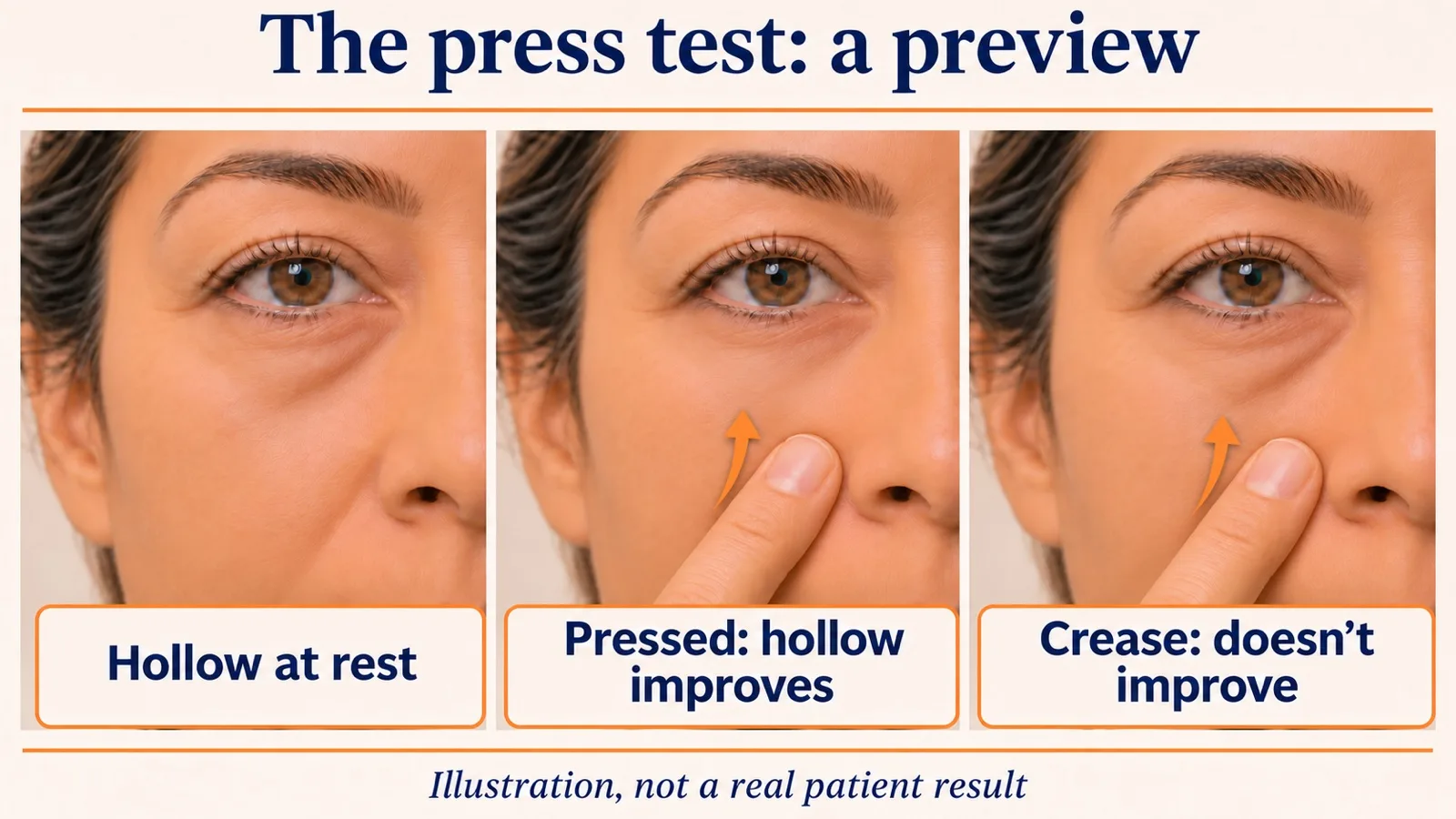
| Tear trough | Filler — if the hollow lifts when the skin is gently pushed up. | If it doesn’t lift, the hollow stays. Forcing filler into that tight space risks it going into the socket. |
| Small hollow beside the nose (when smiling) | A small amount of soft filler in the superficial fat. | Small space — less is more; more can be added. |
| Fat bags | Supporting the cheek softens the gap around them. Tightening with radiofrequency microneedling can push bulges back somewhat. | Fat can’t be removed non-surgically — that’s surgery. Radiofrequency microneedling and AccuTite don’t reduce the fat. We don’t do radiofrequency fat-melting under the eye. |
| Puffiness / malar swelling | Less salt and fluids at night; treating any medical cause; caffeine eye creams. | Superficial filler in that area can cause the same swelling. |
| Thin, crinkly lower-lid skin | A small dose of tox; laser treatments as close to the lid as is safe (not over the eyeball), with topical exosomes on the skin afterward; radiofrequency microneedling to tighten. | Too much tox can stop the lid closing in sleep, and tox can make bags look worse. PRP microneedling bruises a lot here. |
| Dark circles | Caffeine eye creams (swelling, vessels); skin-lightening creams with mild retinol and low-dose non-hydroquinone agents (color); cheek support if it’s a shadow. | — |
| Crow’s feet | Tox is the most effective; lasers and radiofrequency improve the skin. | Smile creases below the outer corner come from the cheek and respond little to tox. |
| Hollow temples | Filler deep on the bone near the brow; hyaluronic acid filler or Sculptra in the wider temple, from the cheekbone arch up to the hairline — lifts gathered skin to some extent. | — |
| Early upper-lid heaviness | A small amount of tox in the upper outer eye muscle so it pulls the brow down less; radiofrequency microneedling on the forehead; filler on the brow bone, in the brow and deep in the temple; a thread lift of the outer brow, with tox first. | Threads may not last long, because blinking pulls against them. |
| Excess upper-lid skin | — | Very hard to treat non-surgically — upper blepharoplasty (surgery) is the honest answer. |
| Thyroid eye disease | Medical treatment of the condition first; it often reduces the bulging. | A lot of fat needs surgery. |
Related treatments:Botox & ToxDermal FillersMorpheus8Morpheus8 + UltraLutronic UltraThread Lifts
Filler under the eye is used with great caution and only for the right indication. Most of the time the most helpful filler isn’t right under the eye — it’s deep in the cheek, where giving back support lets the lower lid sit higher.
| Where | Fillers |
|---|---|
| Deep cheek support (firm) | Restylane Lyft, Restylane Defyne, Restylane Contour, Juvéderm Voluma — or Sculptra or Radiesse, placed deep only |
| Soft areas, such as the small hollow beside the nose | Revanesse Versa, Juvéderm Ultra Plus |
| Just under the skin (very rarely) | A very small amount of a soft filler such as Juvéderm Ultra, or a very thin layer of filler |
How long it lasts: under the eye, generally 9 months to a year.
Hyaluronic acid filler can be dissolved with an enzyme, hyaluronidase. More in our Filler Dissolving FAQs and Safety FAQs. Fillers are for adults only, and we don’t treat with fillers during pregnancy.
These improve skin quality and firmness gradually rather than overnight, and how much they help can’t be predicted at the start. Lasers brought as close to the lower lid as is safe (never over the eyeball) improve the skin, and exosomes applied topically on the skin after the laser can add to that. Radiofrequency microneedling tightens skin, muscle and the septum — it can push bulges back to some extent and lift a falling cheek, though it doesn’t remove fat. PRP and PRF can help the skin, but injected deep they don’t regrow fat in practice, and PRP with microneedling bruises a lot in this area. If filler is indicated, filler gives the quickest result.
Related treatments:Morpheus8Morpheus8 + UltraLutronic UltraFractional CO2
Pricing is personalized to your plan — text (201) 340-4809 for a quote, and see current offers on our Promotions page.
More filler questions are answered on our Dermal Fillers page; tox questions on our Tox page.
Often it’s a hollow, not a bag. With age, the deep fat that supports the cheek shrinks and the cheek falls a little; the gap below the lower lid then looks continuous with the eye, so it reads as a bag even though there’s no bag in it. True bags are fat around the eyeball pushing forward through a thin layer (the septum) that loosens with age. Fat bags stay the same all day, don’t change with salt or water, and can feel firm.
Some people have a slightly larger eye socket and more of a gap between the eyeball and the bone, so the fat around the eye bulges even at a young age. It isn’t only an ageing change. The cheek can still fall later in life on top of that, and that part can be helped.
Water retention. The area has slow lymphatic drainage, so more salt or more fluids the night before can mean more swelling in the morning — sometimes in the upper outer cheek just below the outer corner of the eye (malar swelling, or malar mounds when there’s a lot). Anything medical that makes you retain water makes it worse. It isn’t something filler causes — but filler placed superficially in that area can cause the same kind of swelling.
Several things, often together: pigment from the constant small injury of blinking; fine crinkling and lines that make the skin look darker; blood vessels showing through thin skin; and the shadow of a hollow. Eye creams with caffeine help swelling and vessels. Skin-lightening creams with mild retinol and low-dose, non-hydroquinone lightening agents help the color. When the darkness is a shadow from a hollow, supporting the cheek can help.
Thyroid eye disease (such as Graves’ disease) is an autoimmune condition that enlarges the tissue behind the eye and pushes the eyes forward. The medical condition has to be controlled first; treating it often reduces the bulging. If a lot of fat remains, that needs surgery — it can’t be changed non-surgically.
The best way to tell: gently press the cheek just below the hollow and push upward. If the hollow improves, filler can help — and what you see while it’s pressed is a rough preview of how it can look after. If it’s a crease that doesn’t improve when pressed, filler won’t help it, and forcing filler into it isn’t a good idea. Most of the time the most useful filler isn’t right under the eye at all — it’s deep in the cheek, giving back the support that lets the lower lid sit higher. Dr. Keswani will tell you honestly whether filler fits.
It’s done with great care. Under the eye, filler is always placed with a cannula, never a needle: there are big blood vessels in the deep part of this area, a needle carries a very high risk there, and even a bruise can be big. The other risk is filler forced into the tight space going into the eye socket — not dangerous, but a poor result: that area collects water and swells, and it’s harder for the dissolving enzyme to reach.
Always a cannula. There are big blood vessels deep in this area, and a needle is very high risk there.
Generally 9 months to a year.
For cheek support, firmer fillers: Restylane Lyft, Restylane Defyne, Restylane Contour or Juvéderm Voluma. For softer areas, such as the small hollow beside the nose, soft fillers like Revanesse Versa or Juvéderm Ultra Plus. Very rarely, just under the skin, only a very small amount of a soft filler such as Juvéderm Ultra. Sculptra and Radiesse can also build the cheek — placed deep only, never superficially.
Swelling usually means filler isn’t in the right layer, and then it needs to be dissolved to some extent. The area also has small compartments, so it can swell a little even when the filler is in the right layer — a small amount of dissolving fixes that. And sometimes filler that was fine suddenly swells with something like a viral infection. Tell us — we’ll look and decide together.
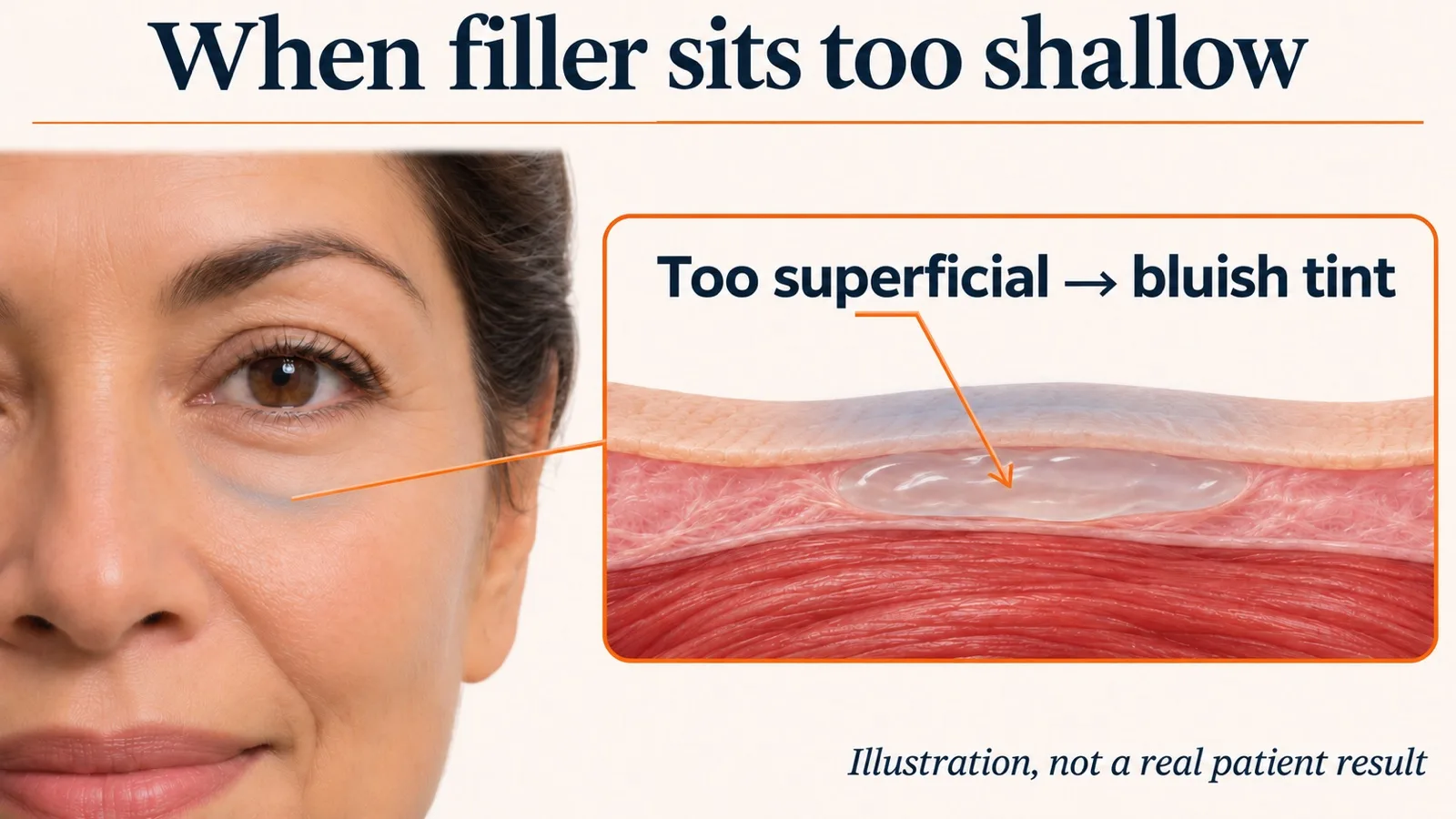
It’s the Tyndall effect: filler very close to the surface of thin skin can show a bluish tint. It isn’t harmful. Some people prefer a little tint to seeing crinkling or a hollow, and then nothing needs to be done; a trained eye may notice it, but most people won’t. If there’s a lot and you don’t like it, it can be dissolved — it’s your decision.
A small dose can reduce crinkling of thin lower-lid skin caused by an active muscle. The dose matters: too much can keep the lid from closing fully when you sleep. And if you have fat bags or water retention, weakening that muscle can make the bags look worse — so it isn’t for everyone.
Usually not well. The creases just below the outer corner of the eye come mostly from the cheek moving up when you smile, not from the eye muscle, so tox has little effect on them. Tox works best on crow’s feet beside the eye.
No — neither reduces the fat. What tightening of the skin, muscle and septum can do is push bulges back to some extent and lift a falling cheek. It’s gradual, not immediate, and how much it helps can’t be predicted at the start. If filler is indicated, filler gives the quickest result.
They can help the skin. Injecting them deep to regrow fat is possible in theory, but in practice it doesn’t give results — and they carry the same risks as other injections (entering a blood vessel, a lot of bruising). PRP with microneedling isn’t the best treatment for this area, because it bruises a lot.
Early changes can be improved: a small amount of tox in the upper outer part of the eye muscle so it pulls the brow down less, radiofrequency microneedling on the forehead to tighten skin, and filler on the brow bone, in the brow and deep in the temple. But when there’s real excess skin collected in the upper lid, the honest answer is upper blepharoplasty — it’s very hard to treat non-surgically.
It’s an option for lifting the outer brow, but it may not last long, because blinking constantly pulls against it. When we do it, a good dose of tox goes in first, so the muscle pulls on the threads less.
Book a Consultation Text (201) 340-4809
Every eye-area plan is individualized; your options and pricing are confirmed with Dr. Keswani.


