
A filler does exactly what its name says: it fills. The fillers we use are made of hyaluronic acid — a substance your body already makes — linked together so it lasts, and reversible to a good extent if ever needed. Used well, they do three jobs: smooth lines in the skin, restore volume that has been lost under the skin, and rebuild the structure close to the bone that holds everything up. They can also define features you were never born with — a stronger chin, a sharper jawline — like a temporary implant, without surgery.
At Forever Medspa every filler treatment is planned and injected by Dr. Deepak Keswani, MD. The goal is never a different face — it’s a better, more refreshed version of yours.
Book a Filler Appointment Text (201) 340-4809
Every plan starts with what is bothering you — and then the best way to fix it. Filler is one of several tools, and sometimes it isn’t the first one.
More on natural results in the general FAQs.
Every filler plan is a plan in layers. The same face may need a soft filler placed in the skin for a line, filler just under the skin for lost volume, and a firm filler deep on the bone for structure. Choosing the right layer — and the right filler and tool for it — is what makes the result look natural and keeps it safe.
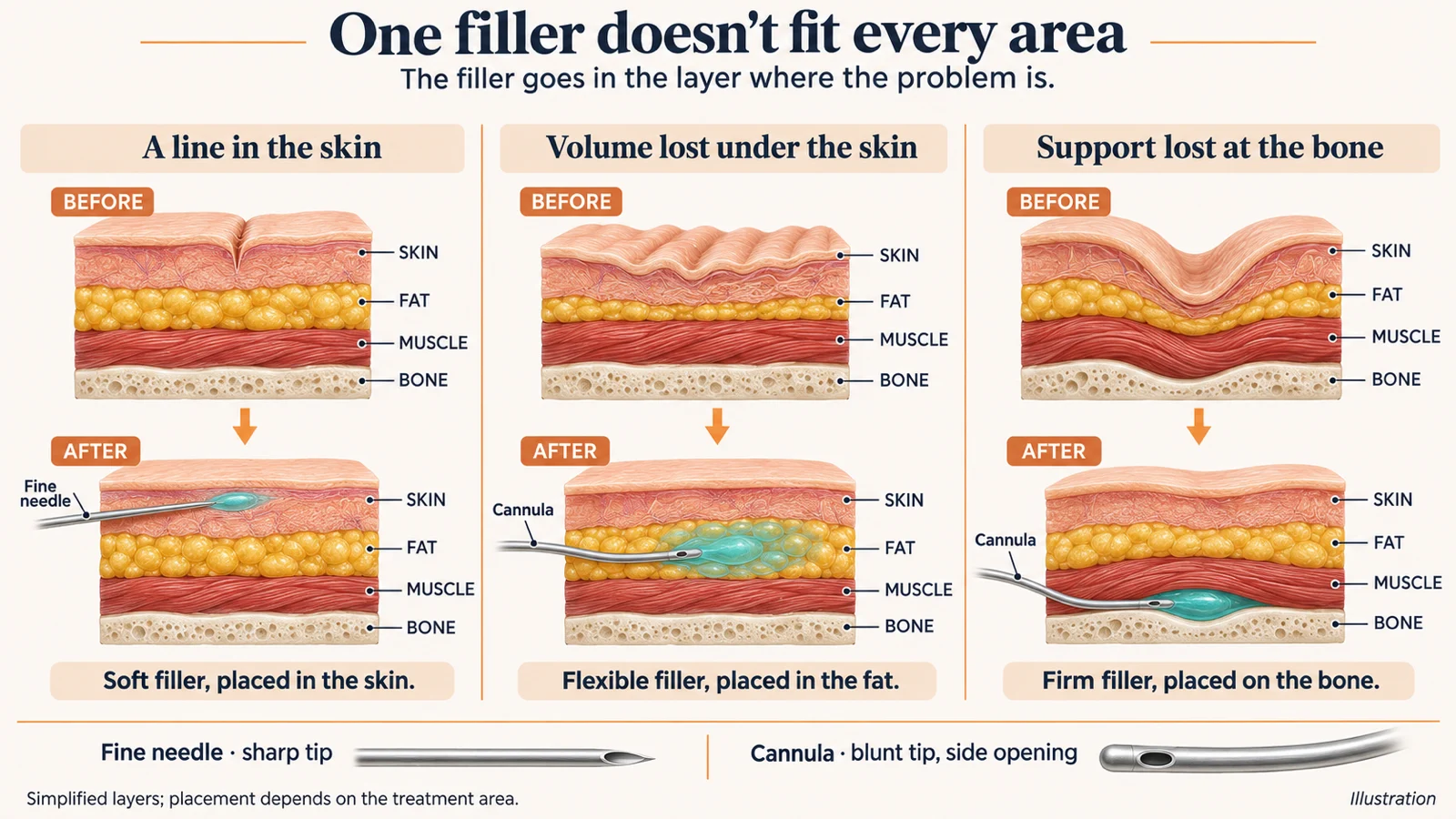
The filler goes in the layer where the problem is. Filler can also be placed on the muscle, for example in the wider temple.
In the skin — lines & creases
A crease is a weak spot where the skin keeps folding. A supporting line of soft filler stiffens it so it stops folding there. Soft fillers blend smoothly; firm ones can show an edge.
Tool: fine needle (a cannula can’t place filler in the skin)
Fillers: Revanesse Versa, Juvéderm Ultra and Ultra Plus
Under the skin — volume
Restores fullness lost with age or weight loss, and smooths crinkled skin over areas like the sides of the chin and the jaw border.
Tool: cannula — less cutting through deep tissue and a lower chance of entering a blood vessel
Fillers: Restylane Contour, Juvéderm Ultra Plus, Juvéderm Volux; Radiesse and Sculptra for larger areas
Deep, on the bone — structure
Rebuilds the support lost as bone and deep fat thin out — or defines features like the chin and jawline. Supporting higher areas often lifts the ones below.
Tool: mostly cannula; a needle at a few precise points (front of the chin, angle of the jaw, beside the brow)
Fillers: Restylane Lyft, Juvéderm Voluma and Volux, Restylane Defyne, Radiesse
Each filler is designed differently — firmer or softer, more lifting or more flexible — and the right choice depends on where it goes and what it needs to do. There’s no single “best” filler; there is a best filler for each place.
| Filler | Character | Where we use it | Rewards |
|---|---|---|---|
| Restylane Lyft | Firm, lifting gel | Structure near the bone — cheeks, chin, jaw, temples; back of the hands | ASPIRE |
| Juvéderm Voluma | Firm, long-lasting gel | Cheeks, chin, temples | Allē |
| Juvéderm Volux | The firmest gel; holds little water | Jawline definition; can sit just under the skin on the jaw | Allē |
| Restylane Defyne | Firm but flexible | Chin, jawline, deeper smile lines | ASPIRE |
| Restylane Contour | Flexible; moves with the cheek | Cheeks (deep and superficial), temples | ASPIRE |
| Revanesse Versa | Soft, smooth | Lines and creases; supporting the smile and marionette lines; temples | — |
| Juvéderm Ultra / Ultra Plus | Soft, smooth | Lines and creases; Ultra Plus also for volume | Allē |
| Radiesse & Sculptra | Collagen builders | Structure and volume through your own collagen — see our Biostimulators page | Merz Xperience+ / ASPIRE |
Why we use a needle in some places and a cannula in others: see Choosing the Right Filler.
Deep, on the bone — main layerUnder the skin — after big volume loss
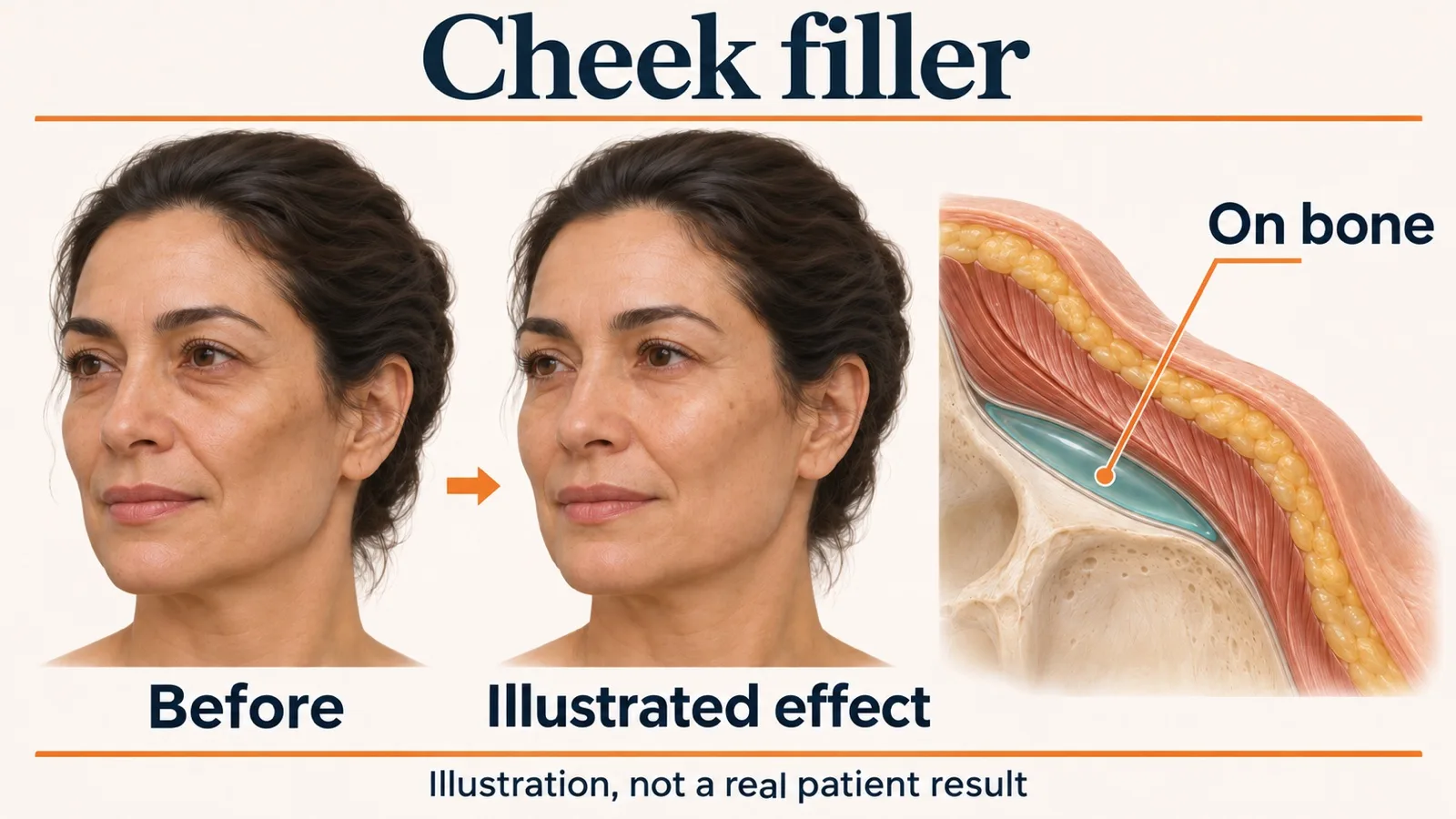
Our most requested area. Cheek filler can restore what time, or cycles of weight loss and gain, have taken — or simply define cheekbones when there’s no aging at all. Placed mainly deep, close to the bone, it supports the tissue above and below it: it softens the top of the smile line, the groove between the under-eye and the cheek, and lifts tissue that has sagged under the eye — a change people notice first, because they look at your eyes. After significant weight loss, some superficial filler is added too. Dr. Keswani uses a cannula here to protect the arteries that run from the cheek toward the eye, works the outer cheek before the inner and the deep layer first, and avoids superficial filler over the cheekbone, where slow drainage causes puffiness.
Fillers we use: Restylane Lyft, Restylane Contour and Juvéderm Voluma; with bigger volume loss, softer fillers such as Revanesse Versa or Juvéderm Ultra Plus can help too.
Deep — front edge & sidesUnder the skin — sides of the chinIn the skin — lines
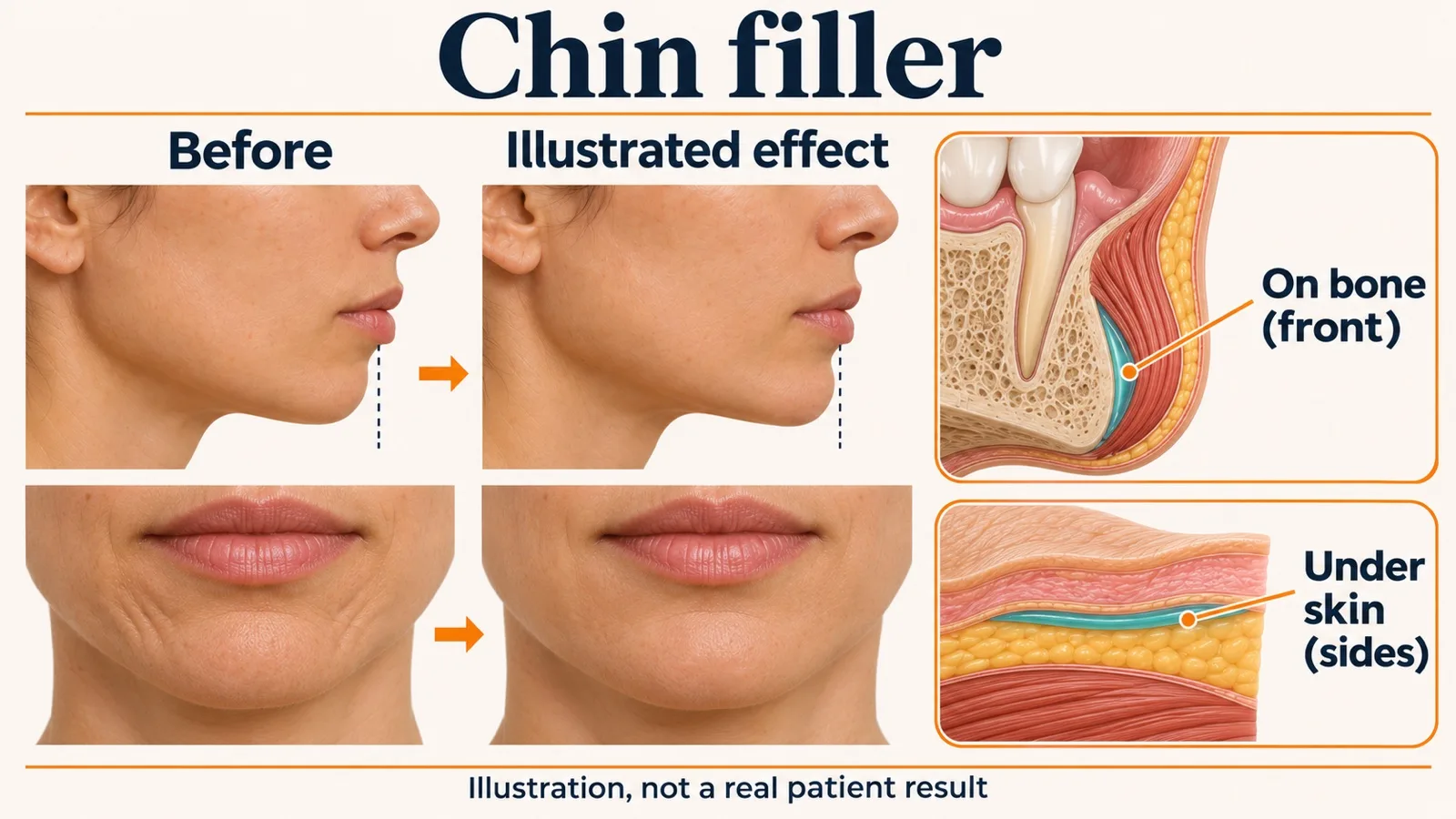
A chin that sits behind the line of the lips makes the lower face look rounder or shorter — and makes jowls look worse than they are. With age, sagging tissue can also crowd forward over the chin. Filler placed along the bone at the front edge and the sides rebuilds that structure, always balanced against the upper jaw and the lips. Volume at the sides of the chin smooths crinkled skin; when thin skin keeps folding with movement, a small dose of toxin to the chin muscles can be added. Deep filler at the front of the chin is placed with a needle (the muscle there is too thick for a cannula); the sides are treated with a cannula.
Fillers we use: Juvéderm Voluma, Restylane Lyft and Restylane Defyne — all FDA-approved for the chin — along the bone; soft fillers such as Revanesse Versa or Juvéderm Ultra Plus for lines in the skin.
Related treatments:Botox & Tox
Deep — angle of the jawUnder the skin — jaw border & around the jowl
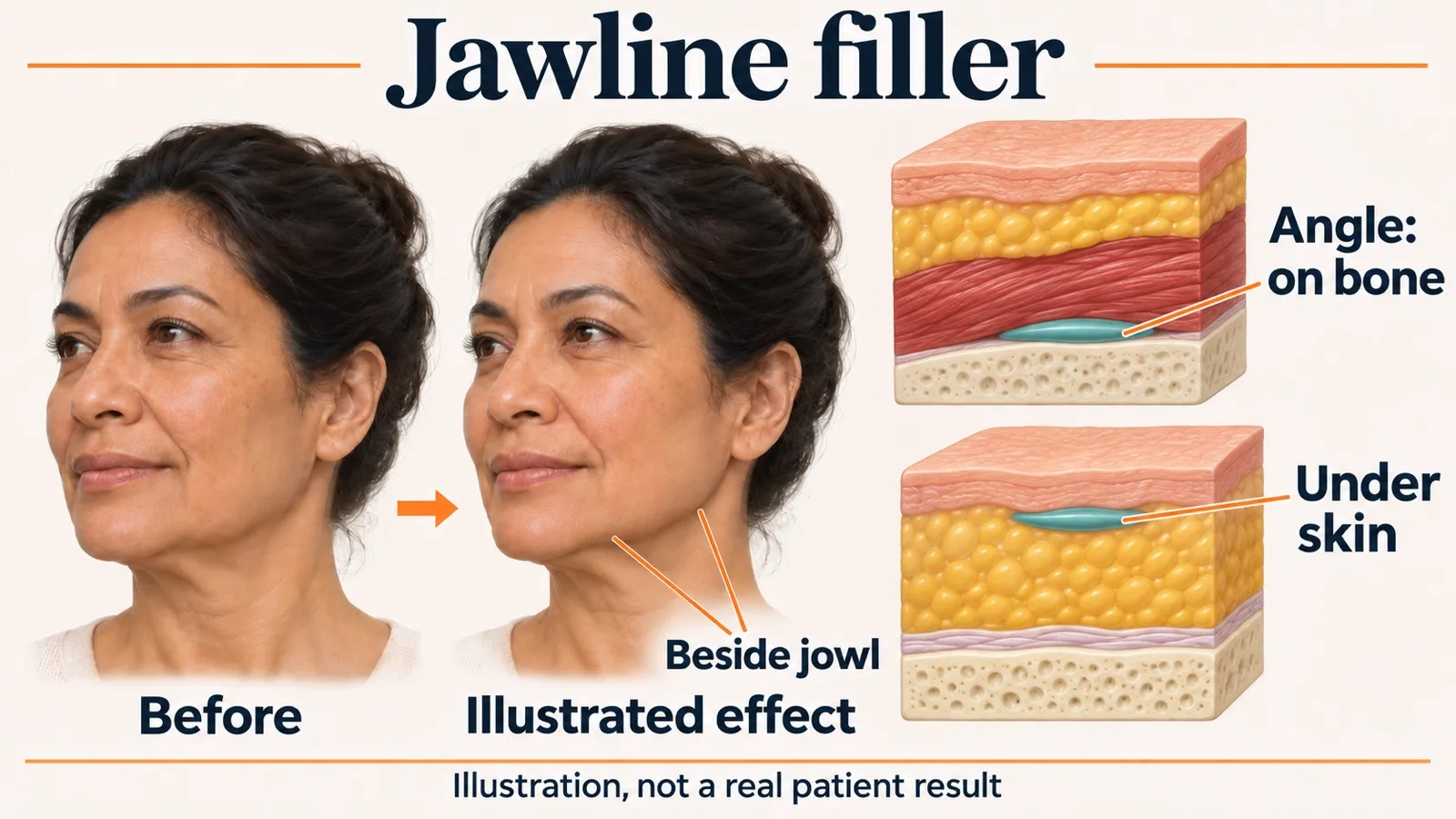
Sought by young and old alike — and by anyone whose jawline has softened with a little extra fullness. Most people need a combination, and filler is one part of it: radiofrequency skin tightening (Contoura or Morpheus8), AccuTite for fullness under the chin and along the jaw, a neck-muscle Botox treatment (the “Nefertiti lift”) and, for a small amount of loose tissue, a thread lift. Filler goes deep on the bone at the angle of the jaw, under the skin along the jaw border, and in the hollows in front of and behind the jowl — never into the jowl itself. Honestly, jowls are hard to treat, and filler alone rarely lifts enough to remove them; we’ll tell you what to expect.
Fillers we use: Juvéderm Volux (FDA-approved for the jawline), Juvéderm Voluma, Restylane Lyft, Restylane Defyne and Radiesse.
Related treatments:ContouraMorpheus8AccuTiteNefertiti Lift (Botox)Thread Lifts
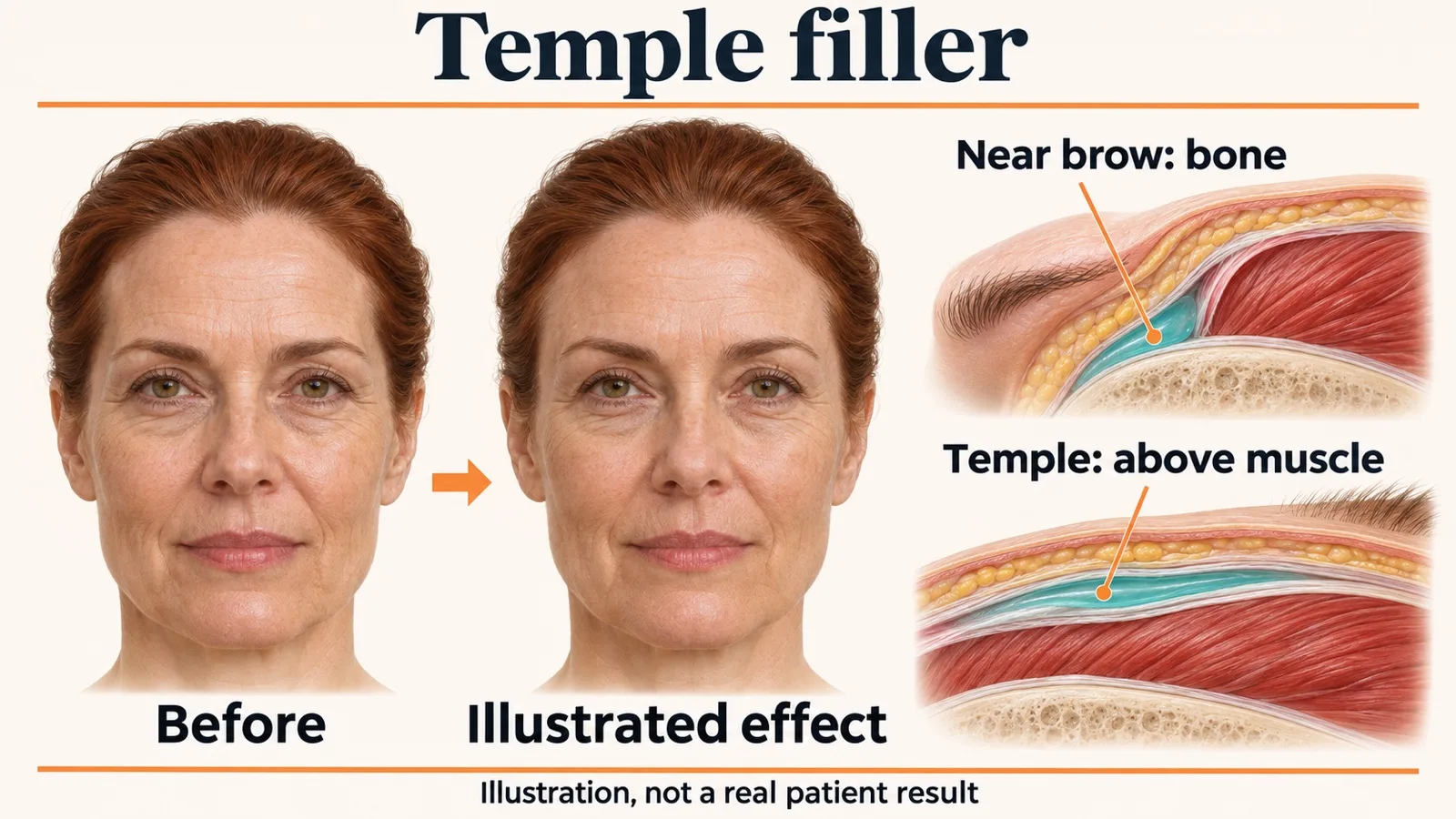
Deep — on the bone beside the browOn top of the muscle — wider temple
Overlooked — and underrated. Hollow temples come from small losses of bone, muscle and fat, and they’re part of the “skeletal” look of weight loss. Filler placed deep on the bone beside the eyebrow supports the brow and softens the sharp temple line seen from the front — usually about one syringe per side. The wider temple, back to the hairline, is treated on top of the muscle, where collagen-building fillers work especially well. The change is subtle, but the whole face looks more refreshed.
Fillers we use: Restylane Contour and Juvéderm Voluma (both FDA-approved for temple hollowing), Restylane Lyft, and the softer Revanesse Versa; collagen builders for the wider temple.
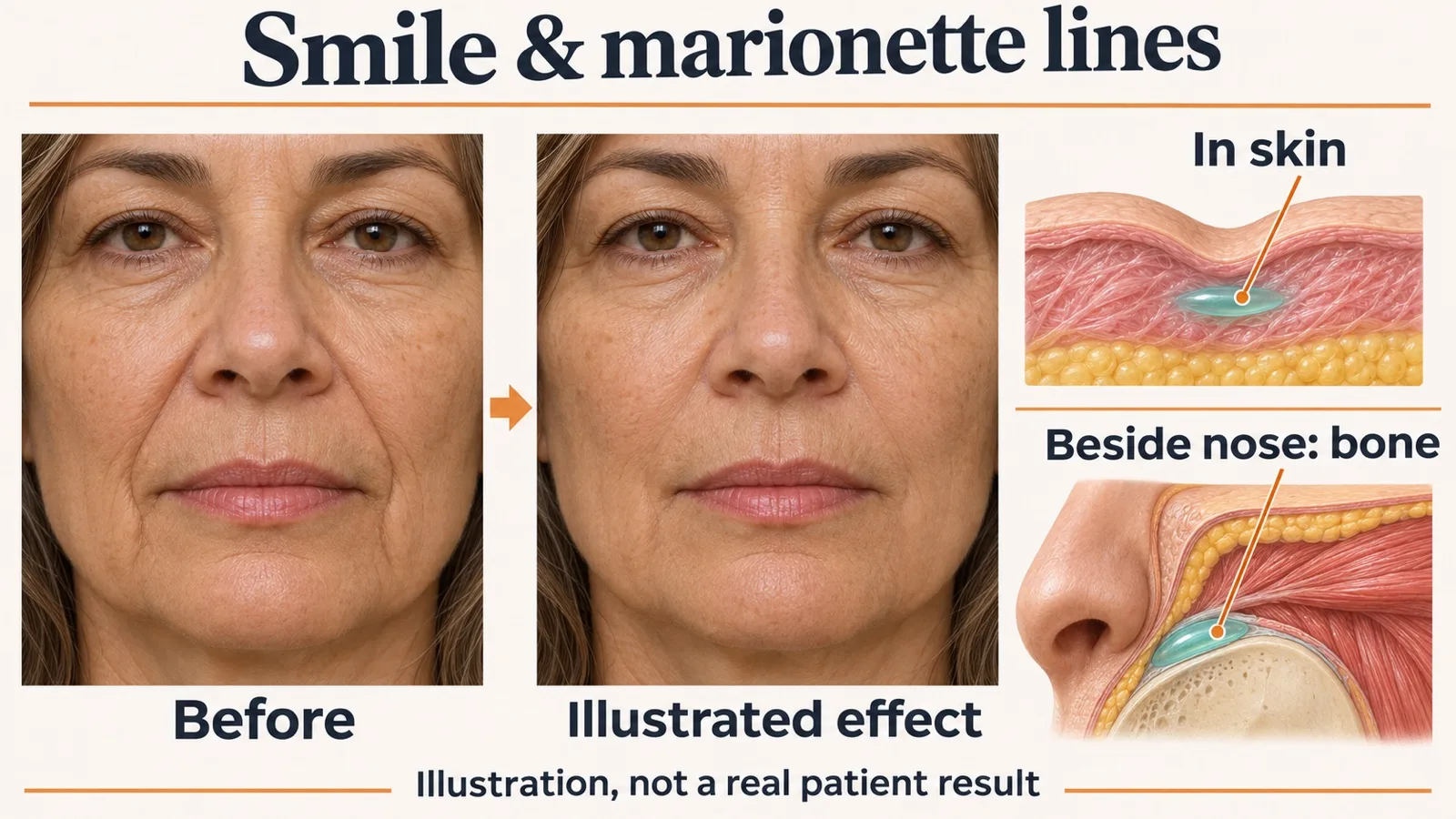
In the skin — the creaseDeep — bone beside the nose
These lines appear even in young faces and deepen with sagging. A crease is a weak point where the skin always folds — like a sheet of paper folded in the same place. A supporting line of soft filler stiffens that spot so it stops folding, and the line softens. A shallow crease needs very little; a deep fold needs more and can be softened rather than fully erased. For smile lines, filler deep at the bone beside the nose — and support from the cheek above — makes a real difference. Marionette lines rarely improve just by bringing the chin forward; they usually need filler in the line itself, from the mouth corner toward the chin, often combined with chin filler.
Fillers we use: soft fillers such as Revanesse Versa and Juvéderm Ultra Plus in the crease; a malleable filler such as Restylane Defyne for a deeper fold.
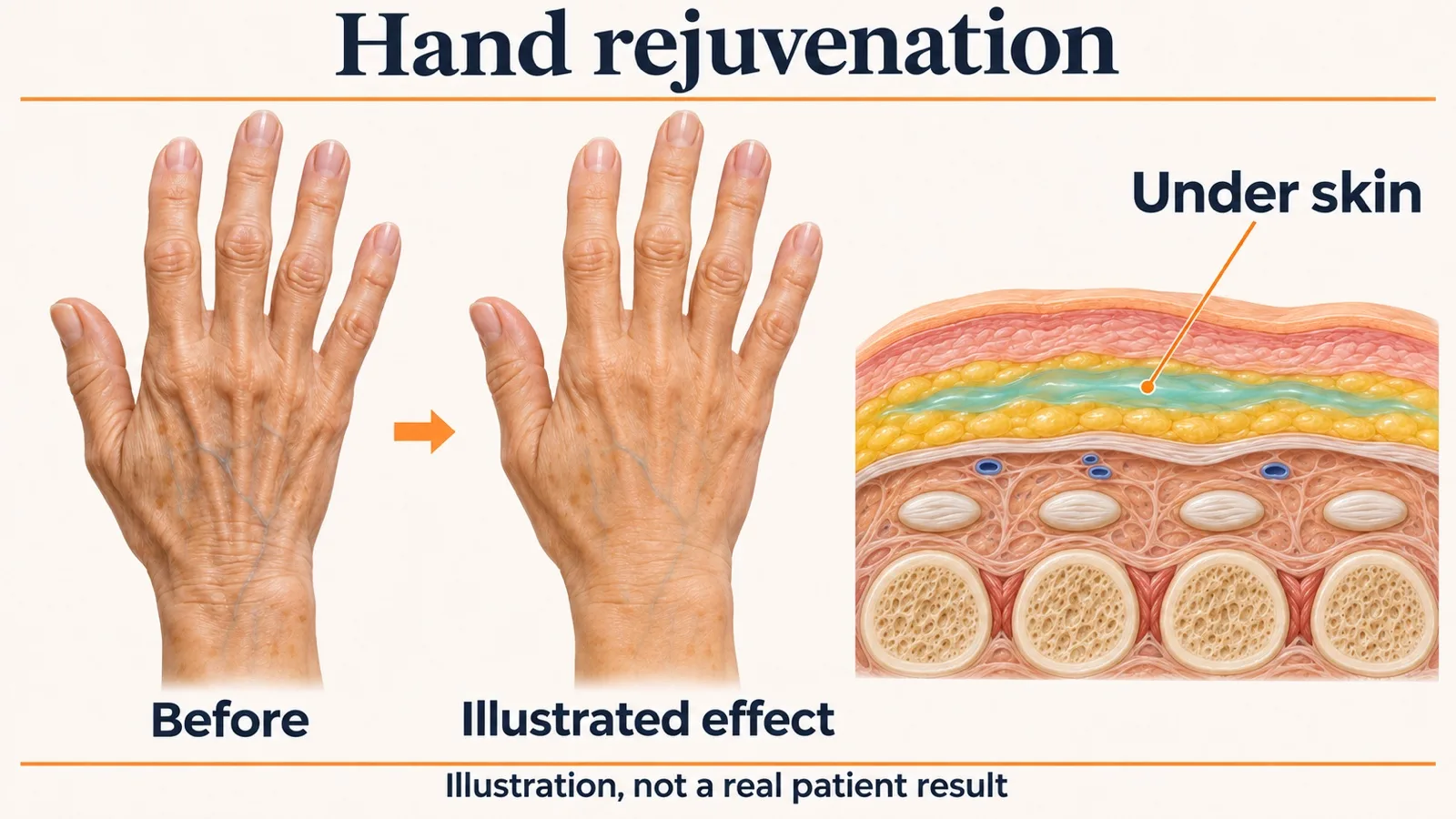
Under the skin — spread with a cannula
As the small muscles and volume of the hands thin out, bones, tendons and veins start to show. Filler restores the fullness under the skin; laser (such as the Lutronic Ultra) treats sun damage, and laser or radiofrequency (such as Morpheus8) improves thin, crinkly skin. Most people need about three syringes in total for both hands (Radiesse starts at about one per hand). Dr. Keswani uses a cannula — very safe, with fewer bruises — and spreads the filler rather than massaging it. Expect more swelling than on the face: usually about 2 days, sometimes a week.
Fillers we use: Radiesse and Restylane Lyft (both FDA-approved for the back of the hands), or softer fillers.
Related treatments:Lutronic UltraMorpheus8
Hyaluronic acid fillers can be reversed to a good extent with an enzyme, hyaluronidase, which breaks the cross-links so your body can clear the filler. A small bump or a puffy spot often settles in one session; dissolving a full syringe usually takes several, about a week apart. Details in Filler Dissolving FAQs.
Some lines come from muscles pulling rather than lost volume, so filler and toxin often work best together — usually in the same visit. More in Filler + Botox FAQs.
Related treatments:Botox & Tox
Looking for under-eye or lip treatment? Those have their own pages — and we’re honest that filler directly under the eye is rarely the right answer.
1. Consultation — every time. Dr. Keswani reviews your concern, your medications (especially blood thinners) and your whole face, and recommends the plan — honestly, including when filler isn’t the right tool.
2. Treatment. Somewhat uncomfortable but very well tolerated; numbing is generally only needed for lips. About 15–20 minutes for one area, up to about an hour for several.
3. Aftercare. Ice wrapped in a cloth for 15 minutes every hour for the first 12 hours. Don’t touch, massage or press the area for 24–48 hours. Skip strenuous exercise, saunas, steam and heat for 24 hours; it’s best to go easy on alcohol for a day. Makeup and skincare can go back on the next day. Sleep with your head raised, not on your side or stomach, for 24–48 hours. No facials, massages or aggressive skin treatments for 2 weeks, and no tight goggles or glasses for 72 hours after cheek or under-eye filler. Tylenol is fine for discomfort; bruises can take up to 2 weeks to fade.
Call us right away at (201) 340-4809 if you notice severe pain, an unusually tender area, a pale, white, dusky or discolored patch, more visible engorged veins, a cold feeling in the skin, or pus-like spots. These are rare signs that a blood vessel may be blocked — treatable, and treatment works best when it starts early.
4. Results & refinement. You’ll see the change right away, with swelling settling over the following days. If anything needs adjusting, we’ll see you back.
Pricing is personalized to your plan — text (201) 340-4809 for a quote in minutes, and see current offers, including our filler + tox combinations, on the Promotions page.
It depends on two things: how much filler your area needs to give you a result you’re happy with, and how much water your body holds — hyaluronic acid attracts water, and that varies from person to person. As a general guide, results last about 9 to 12 months in the lips and in most areas. Fillers made with Vycross technology (Juvéderm Voluma and Volux) or XpresHAn technology (Restylane Defyne and Contour) may last you longer.
Our fillers are made of hyaluronic acid (HA) — a substance your body already makes every day and keeps in the skin, between soft-tissue layers and in the joints. Natural HA exists as loose strands that the body clears quickly. Filler HA is linked together with tiny cross-links, so only its outer surface is exposed and your body breaks it down slowly — that’s why it lasts. Fillers can smooth lines in the skin, restore volume that has been lost under the skin, or add structural support close to the bone. They can also define features — a stronger chin or jawline — acting like a temporary implant without surgery.
Natural means balanced. We assess the whole face — upper, middle and lower thirds — and treat what is most out of proportion first. Sometimes that isn’t volume at all: if the skin is the main issue, skin treatment comes first (tox, a skin-level filler, laser or radiofrequency). Adding more to an area that is already full while an emptier area is left alone is what looks unnatural, because aging and weight loss never happen that way. Keep the proportions right and the result reads as you, refreshed.
Yes — the goal is a better, more refreshed version of you, not a different person. Our eyes read age in a blink, from patterns: which parts of the face have changed most over time. Dr. Keswani identifies those parts and restores them toward how they used to look. That is also why the same product in the same area can give very different results in different hands — it depends on the assessment, an understanding of how faces age, and balance.
Hyaluronic acid fillers are reversible to a good extent. An enzyme called hyaluronidase breaks the cross-links that hold the filler together, turning it back into free HA strands your body can clear. A small bump or a puffy spot often settles with one small session; dissolving a full syringe usually takes more than one session. See Filler Dissolving below.
It’s somewhat uncomfortable but very well tolerated, and numbing is generally only needed for lips. One area takes about 15–20 minutes; several areas in one visit take up to about an hour, including a longer consultation. There’s a consultation every single time — sometimes quick, but always done — and a review of your medications, especially blood thinners.
Because most concerns have more than one cause. A softer jawline may need skin tightening, a neck-muscle (platysma) treatment and filler; aging hands may need laser for sun damage as well as volume. Filler is often one part of a combination — and trying to make filler do what a combination should is one of the main reasons faces end up overfilled.
Each filler is built for a job. Firm, lifting gels (such as Restylane Lyft, Juvéderm Volux and Voluma) go deep, close to the bone, where structure is needed. Flexible gels that still hold shape (Restylane Defyne and Restylane Contour) move naturally with the curves of the cheek and chin. Soft, smooth fillers (Revanesse Versa, Juvéderm Ultra and Ultra Plus) go into the skin for lines and creases. Radiesse and Sculptra build structure and volume through your own collagen.
A crease is a weak point where the skin always folds — like a piece of paper folded in the same place. A supporting line of soft filler in the crease stiffens that weak point so it stops folding there. Because that filler sits right in the skin, a firm filler can leave an edge you can see and is hard to blend; a soft filler can be molded smooth. Firm fillers can even separate in a crease and make the line look worse. For a deeper fold, a malleable filler such as Restylane Defyne is used.
Both have a place. Lines in the skin are treated with a fine needle, because a cannula can’t place filler inside the skin — it’s too tough. Deeper volume and structure are usually placed with a cannula (a blunt, flexible tube), which is safer in two ways: it cuts less through deep tissue, where bleeding and bruising are bigger and harder to see, and it is less likely than a needle to enter a blood vessel. A few deep points — the front edge of the chin, the angle of the jaw, beside the eyebrow — are best reached precisely with a needle, using knowledge of which layer the vessels run in. That anatomy knowledge matters more than the tool.
It depends on your anatomy and goals — Dr. Keswani will give you an honest number at your consultation. As a general guide: cheeks 1–3 syringes, chin 1–4, jawline 1–2 per side, temples about 1 per side, and hands about 3 in total for both hands. Text us at (201) 340-4809 and we’ll give you a quote.
Often, yes. Filler placed deep in the cheek supports the tissue that has sagged from under the eye, softens the groove between the under-eye and the cheek, and improves the top of the smile line. Because people look at your eyes first, that change is noticed by everyone. Filler directly under the eye is a different matter — it’s rarely the right answer, and we’re cautious about it.
Honestly, jowls are hard to treat, and filler alone rarely lifts enough to remove them. Filler is placed around the jowl — along the jaw border, in the hollow in front of the jowl and behind it — never into the jowl itself, which would make it look heavier. Most people need a combination: radiofrequency skin tightening, a neck-muscle treatment (the ‘Nefertiti lift‘), and for a small amount of loose tissue, a thread lift, which lasts about 4–12 months and isn’t for everyone.
The temples are overlooked — and underrated. Hollowing comes from small losses of bone, muscle and fat, including an extension of the buccal fat that also holds the cheeks up. When it empties, you see hollow temples and hollow cheeks: the ‘skeletal’ look of weight loss. Restoring it gives a subtle change that makes the whole face look more refreshed and balanced. And it works the other way too: filling the cheeks while the temples stay hollow makes a face look bonier, not younger.
There are two kinds. The first is an outcome you didn’t expect — which is why the consultation matters and why you should be comfortable with change (after filler, people sometimes notice things that were always there). The second is a complication: bruising and swelling are common; serious bleeding is very unlikely; filler can occasionally travel along a path of least resistance (migration) and then needs dissolving; and, rarely, filler can enter a blood vessel. Knowledge of the anatomy and experience reduce all of these.
It’s possible but extremely rare. In risky areas — around the eyes, the frown lines, or right in a blood vessel’s layer — filler entering a vessel can block it, and in the rarest cases this can affect vision. Think of driving to the grocery store: nobody expects an accident, accidents do happen, and they’re more likely with an inexperienced driver. Knowing the anatomy, the vessel layers, and when to use a cannula keeps that risk very low, and if it ever happens it is treated right away.
Call us immediately if, within hours to a day of treatment, you notice an unusually tender area, a discolored, pale, white or dusky patch, more visible engorged blood vessels, a cold feeling in the skin, or severe pain. Pus-like spots on the surface or a patch that develops over a few days are also urgent. These are signs a blood vessel may be blocked — rare, but treatable, and treatment works best when it starts early.
Aspirin and anti-inflammatories (like ibuprofen) only mean we hold pressure a little longer and there’s a slightly higher chance of a bruise — they’re not a reason to cancel. Blood thinners that affect clotting factors — such as Coumadin, Lovenox, Eliquis and heparin — can bleed later and deeper, so filler generally isn’t done unless you can safely be off the medicine for about a week. We never recommend stopping it ourselves: any pause must be confirmed with the doctor who prescribed it. If you’ve been on a blood thinner long-term and have had filler before without bleeding problems, treatment may be possible with caution.
We don’t treat with fillers during pregnancy at our clinic — your plan will be here when you’re ready, and we’re happy to map it out in advance. Filler while breastfeeding is fine; just let us know at your consultation.
Dental work isn’t a strict rule. Vaccines are a soft rule rather than a hard stop: a vaccine can cause soreness, swelling, fever and an inflammatory response, and filler can join in that response, so there may be more swelling. If you can, leave about two weeks between them.
An overfilled face isn’t a complication — it’s an outcome nobody wanted. It comes from putting filler in the wrong place or layer, ignoring balance between the thirds of the face, or asking filler to do something that needs a combination of treatments. Lymphatic drainage matters too: some areas drain slowly and puff up if filler is placed too superficially. A careful first assessment prevents it. Filler is done because a concern is bothering someone — not just because someone has decided they want filler.
Hyaluronic acid holds water, and the body holds a little more water overnight, so some people notice slightly more fullness in the morning and less by evening. Filler can also swell along with your body’s response to a viral infection. These aren’t complications — they can be adjusted, often with a small amount of dissolving in the swollen spot while keeping the rest of your result.
When filler has collected in one place, sits in a layer where it isn’t wanted and makes the face look fuller, or swells along with inflammation (for example after a viral infection — not an allergy). Areas with slow lymphatic drainage, the under-eye compartments, and the constantly moving lips are where this happens most.
There’s no exact science. A small bump or a puffy spot often settles with one session and a small amount. Dissolving a whole syringe usually takes several sessions, because the enzyme opens small spaces in the filler that expand slowly; repeats are done about a week apart if needed. Results start to show anywhere from 2 hours to 2 days.
It’s done with a thin needle (sometimes a cannula). It burns a little, and numbing can be used. A few people can be allergic to the enzyme, so the clinic is equipped and trained to treat an allergic reaction. Some temporary swelling is normal as the released filler fragments shift water.
If the problem was simply too much filler, there’s usually no point in refilling. If filler was in the wrong place, new filler can generally go in after about 2 weeks — in the same or a nearby area — once the water has settled and we can see your true starting point.
Usually, yes — even in the same area. We hold the toxin only when there’s a lot of swelling after filler, or a risk that the swelling could carry the toxin to a neighbouring muscle. The plan depends on your concern, your preferences and your comfort level.
Some lines come from muscles pulling, not just from lost volume. Around the mouth and chin, the muscle that pulls the mouth corners down can deepen marionette lines, the chin muscle can cause dimpling, and the muscle that pulls the corners sideways can create small lines beside them. A tiny dose of toxin softens these where filler alone can’t. The forehead, frown lines and the area around the eyes, on the other hand, are usually toxin areas, not filler areas. Ask about our filler + tox combinations — text us at (201) 340-4809 for a quote.
Book a Filler Appointment Text (201) 340-4809
Treatment is individualized; your plan and pricing are confirmed with Dr. Keswani.


