By Dr. Keswani, MD — Forever Medspa & Wellness Center
“Which filler is the best?” is a fair question, but it doesn’t have one answer. The better question is: best for what job?
Fillers are made with different technologies, and each one is built for a different purpose. Choosing the right one, and the right way to place it, is a big part of getting a result that looks natural.
First, what a filler actually is
Our fillers are made of hyaluronic acid. Your body already makes hyaluronic acid every day and keeps it in the skin, between the layers of soft tissue, and in the joints. In the body it exists as free strands that are broken down quickly.
Filler hyaluronic acid is different. Its strands are held together by small side links, so only the outer part is exposed. The body can’t reach deep inside, so it breaks the filler down slowly. That is why filler lasts.
Filler can do three main jobs:
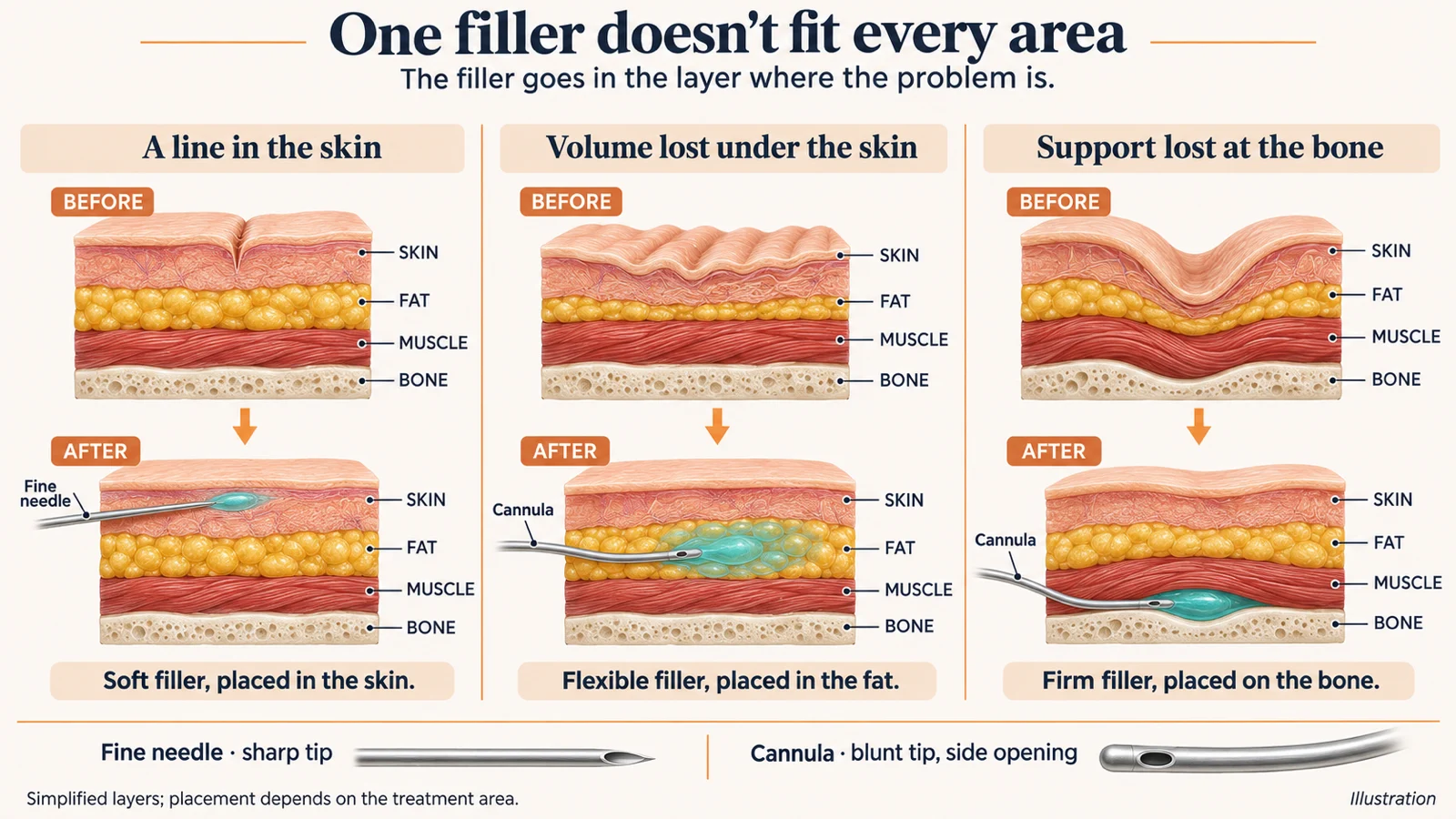
- In the skin, to soften lines and creases.
- Under the skin, to restore volume that has been lost.
- Deep, close to the bone, to rebuild structural support that fades with age.
It can also define features, such as a stronger chin or a sharper jawline, working like a temporary implant without surgery. Each of those jobs calls for a different kind of filler.
Firm fillers for structure
Close to the bone, I want fillers that are firm and hold their shape. These include Restylane Lyft, made with NASHA technology, and Juvéderm Voluma and Juvéderm Volux. Because Volux does not hold much water and is firm, it can also be placed just under the skin.
This is the kind of filler that supports the cheeks. Most cheek filler goes in the deep layers to hold the tissue up. Someone who has lost a lot of volume may need some filler closer to the surface as well, but mainly deep.
Radiesse is another option for structure. It is very firm, holds its shape where it is placed, and keeps that shape while your own collagen develops. Placed strategically, Sculptra can help with structure too.
Flexible fillers that move with you
Some areas need support that still bends with expression. Restylane Defyne and Restylane Contour are made with XpresHAn technology: firm, but with some flexibility. Contour can be placed both deeper and more superficially in the cheek, and it moves very well with the curves of the cheek. Defyne is a good choice for the chin and for deeper folds.
Soft fillers for lines in the skin
For lines and creases in the skin, I use soft, easily molded fillers: Revanesse Versa, Restylane Kysse (mainly for lip lines), Juvéderm Ultra Plus, and Juvéderm Ultra for very fine lines.
Here’s the way I like to explain it. Think of a piece of paper folded in the same place again and again. That crease becomes a weak point, and the paper always folds there. If you stiffen the paper at that crease, it stops folding there.
Skin works the same way. A crease, like a smile line or a marionette line, is a weak point where the skin always folds. A supporting line of soft filler stiffens that spot, so it doesn’t fold as much, and the line improves.
So why not use a firm filler there? Because a crease filler sits right in the skin, there’s a chance you could see its edge. A firm filler is very hard to blend smoothly at that level. A soft filler can be molded so it looks smooth. Firm fillers in a crease can even separate and make the line look worse. For a deeper fold, a malleable filler like Restylane Defyne can be used.
Every one of these products is a good filler. The question is never which brand is better. It is which one fits the job in front of me.
Needle or cannula?
How the filler is delivered matters as much as which filler it is. I choose for each area based on its risk, the anatomy, and how the area can be reached.
Lines in the skin are treated with a fine needle. A cannula can’t place filler in the skin, because skin is too tough.
For deeper volume and structure, I usually prefer a cannula, a blunt, flexible tube. It is safer in two ways:
- It does less cutting through the deeper tissues, where bleeding and bruising can be bigger and harder to see and press on.
- It is less likely than a needle to enter a blood vessel.
There are a few deep spots where a needle reaches more precisely: the front edge of the chin, where there is a lot of muscle a cannula struggles to pass through; the angle of the jaw, deep on the bone; and the area just beside the tail of the eyebrow at the temple. In the hands, I use a cannula and spread the filler, which keeps treatment very safe with fewer bruises.
Still, the tool is not the whole story. Knowing which layer the blood vessels run in, deeper or more superficial, matters more than simply choosing a needle or a cannula.
Layers matter too
Even the same filler behaves differently depending on depth. In the temples, for example, most people benefit from filler placed deep, on the muscle rather than right under thin skin. A strong filler placed too superficially under thin skin can look irregular.
Does the type change how long it lasts?
It can. How long filler lasts depends on how much your area needs for a result you’re happy with, and on how much water your body holds. As a general guide, results last about 9 to 12 months in the lips and in most areas. Fillers made with Vycross technology (Juvéderm Voluma and Volux) or XpresHAn technology (Restylane Defyne and Contour) may last longer.
A plan, not a product
When you come in, I don’t start by picking a syringe. I assess what you’re asking for and how your face has changed, then match each area with the filler and the technique that suit it. Often that means more than one product in one plan.
You can see the areas we treat on our Dermal Fillers page. For pricing, text us or visit our Promotions page.
- Book a filler consultation
- Text us at (201) 340-4809