
Biostimulators are injectables that stimulate your body to build its own collagen. The collagen forms locally — only where the product is placed, not throughout the body — so it creates fullness exactly where it’s wanted, gradually and naturally, because the new volume is your own tissue.
We use two: Sculptra and Radiesse (including hyperdilute Radiesse). Which one, how much and how often depends on why you’re here — to define, to restore volume after major fat loss, or to maintain as you age. Every plan is made and injected by Dr. Deepak Keswani, MD.
Book Sculptra Book Radiesse Text (201) 340-4809
A biostimulator is placed beneath the skin. The body recognizes it as something foreign, tries to break it down, and in the process builds new collagen around it. That collagen creates fullness right where it was placed.
That’s different from treatments that build collagen in the skin: lasers and radiofrequency create tiny, controlled injuries that the skin repairs with new collagen. Biostimulators work deeper, restoring fullness rather than skin quality.
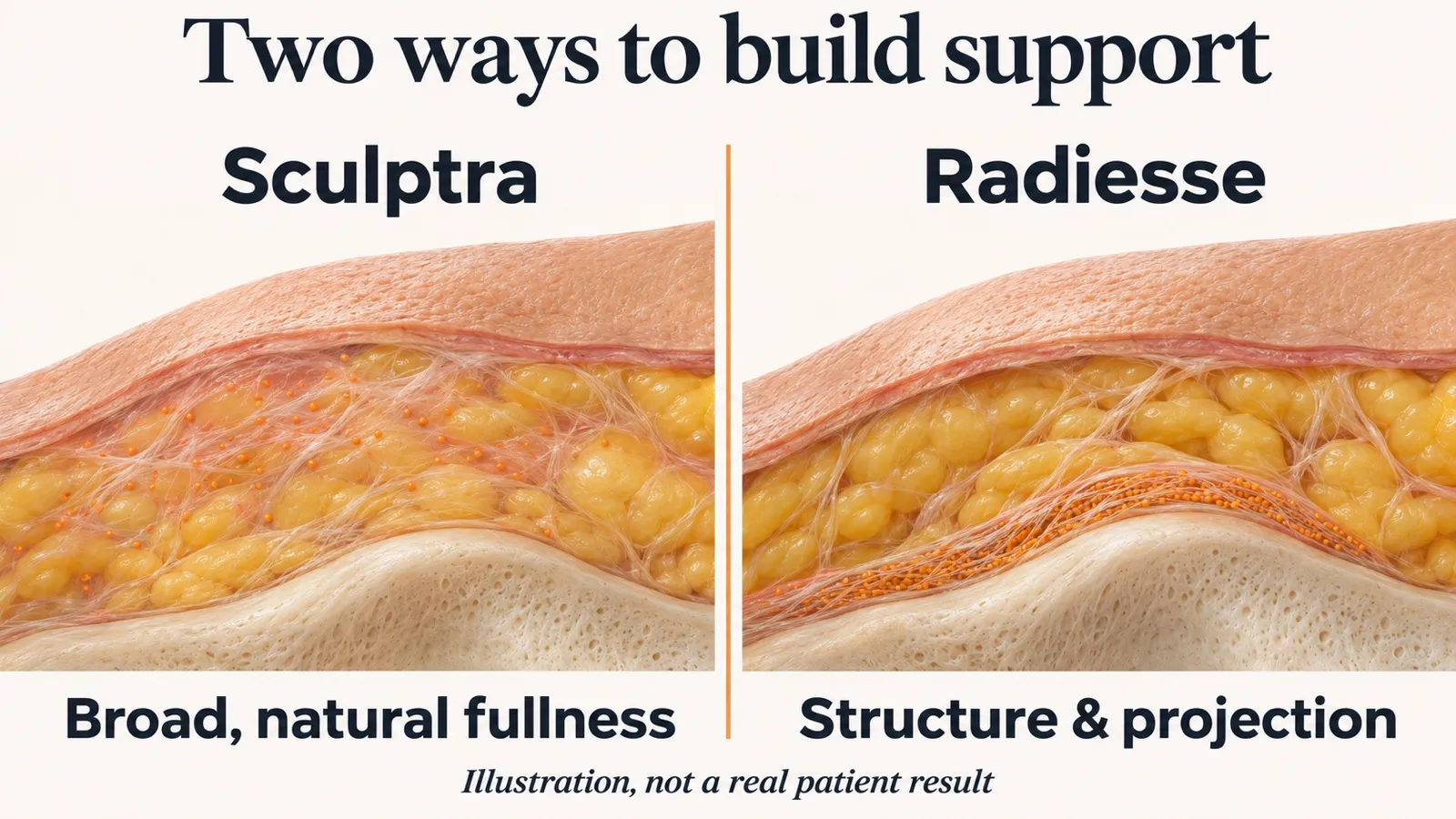
| Sculptra | Radiesse | |
|---|---|---|
| What it is | Poly-L-lactic acid — a powder in a glass vial, reconstituted with sterile water and lidocaine a few days ahead | Calcium hydroxylapatite particles in a firm gel |
| When injected | Liquidy — spreads over an area | Firm — stays where it’s placed |
| Best at | Broad, natural fullness: front and side cheeks, temples, back of the jaw | Structure and projection: along the cheekbone, shaping a jawline, softening the smile-line crease; hyperdilute for broad volume |
| How it builds | Collagen forms as the body breaks it down | The gel gives early structure; as it’s absorbed, the calcium particles stay and collagen and elastin build around them |
| Results | Gradual; about 3 months, improving for 3–12 months | Some fullness right away, which settles as the gel breaks down, then slowly returns as collagen builds |
| Can it be dissolved? | No | No |
Not sure which fits you? See Radiesse & hyperdilute FAQs or text us.
The reason you’re here decides the product, the amount and how often — each one needs a different plan.
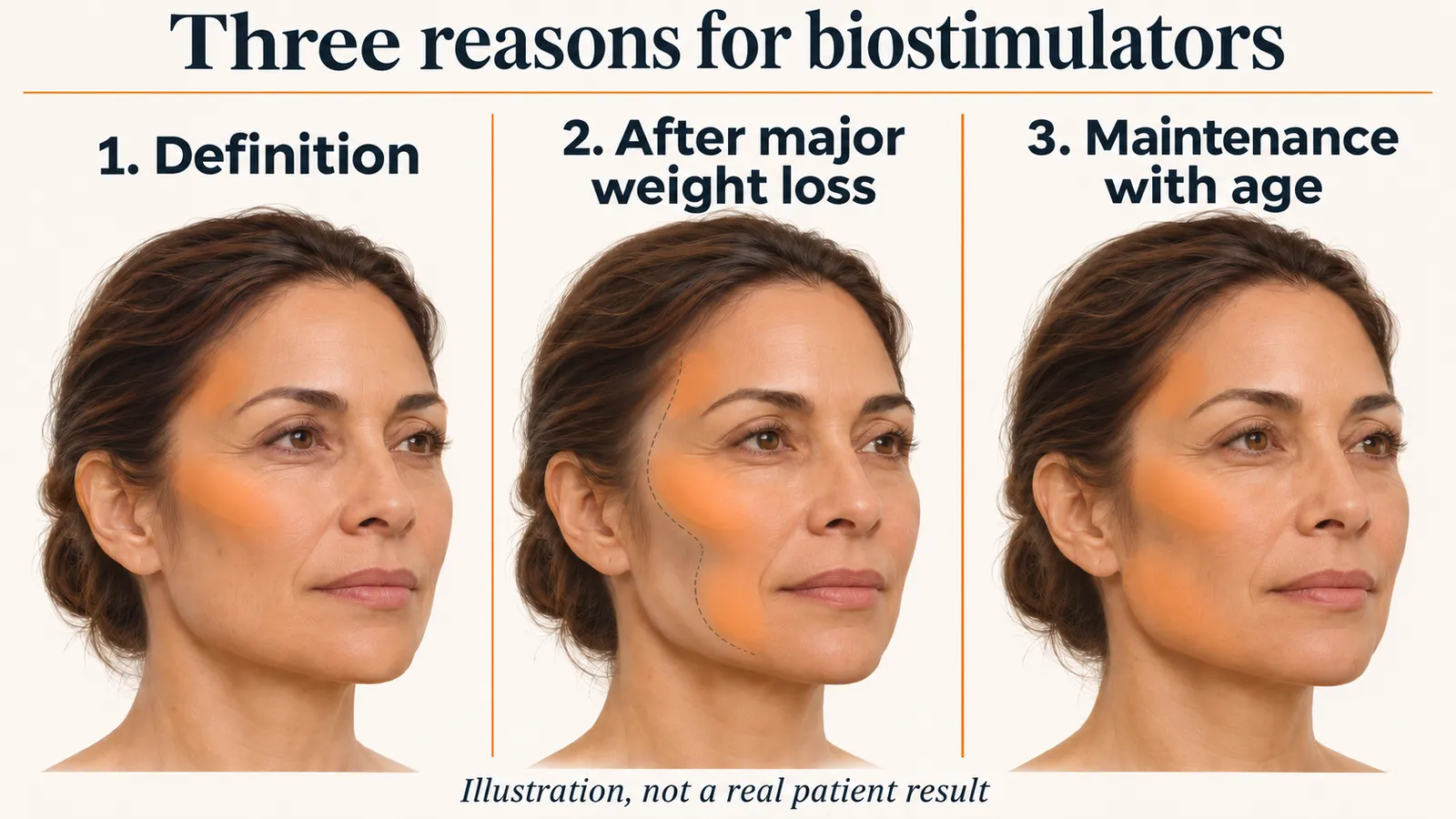
1. Definition & projection
For a face that isn’t very hollow but wants more definition — we’re creating something new.
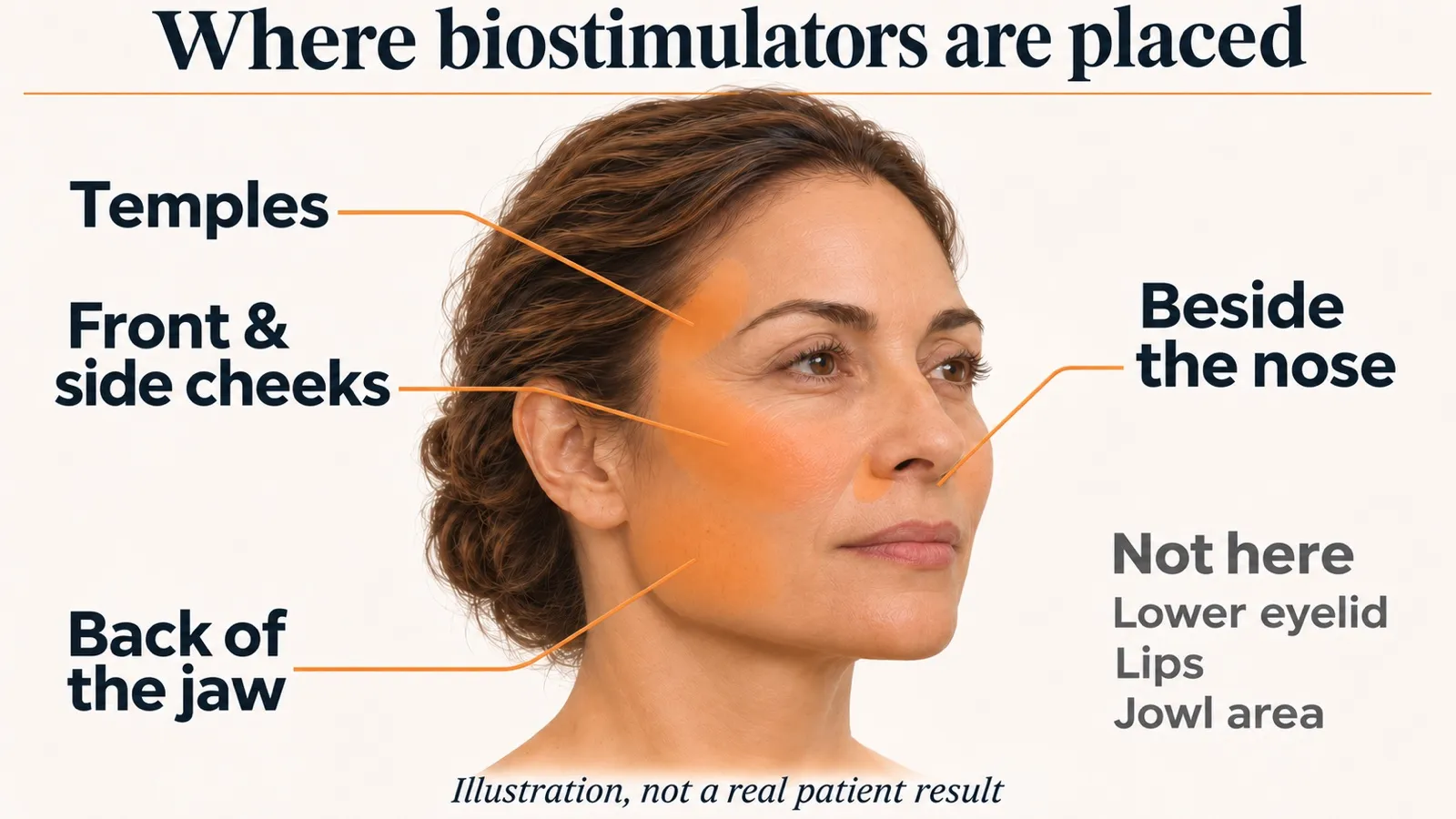
Where: front cheeks, side cheeks, temples — areas over bone. Sculptra can’t draw the jawline line itself (it’s too liquidy), but it can build the back of the jaw. Plan: about 1–3 sessions.
2. Hollowness after major fat loss
After a big weight loss — from GLP-1 medicines or other peptides, or after an illness.
Where: temples, back of the jaw, the buccal area beside the mouth, front cheeks, the hollow beside the nose. Plan: a defined course of about 3–4 sessions (for example 2, 2, 1 and 1 vials), estimated at the start; a small adjustment may follow once the full effect shows.
3. Maintenance as you age
With age we lose bone and deep fat in the temples and along the cheekbones; support at the back of the jaw helps reduce jowls.
Where: front and side cheeks, temples, back of the jaw. Plan: lifelong maintenance — about 1–2 vials a year, or one vial twice a year, on a fixed schedule.
If your face is already full and round and you want more definition, Sculptra isn’t the answer — it mainly creates fullness. Hyaluronic acid filler, which stays in one place and has more structure, gives bonier definition; full-strength Radiesse can also work, since it has structure from the start.
Related treatments:Dermal FillersEye AreaSculptra Butt Lift
Biostimulators can slow down the visible ageing of the face — but only when done in proportion. You can treat only certain places, and the rest of the face keeps ageing. Done in proportion, you look better than you would have; done out of proportion, it looks odd. The same product can give very different results depending on how it’s used. So every plan starts the same way:
Read more: Will I Still Look Like Me? How We Keep Filler Results Natural.
Pricing is personalized to your plan — text (201) 340-4809 for a quote in minutes, and see current offers on our Promotions page.
Watch for these and call us right away at (201) 340-4809: an area turning pale or white (blanching), or feeling cold — and the later signs, pain or mottled, bluish skin. These are rare, but they matter after any filler.
Go to the emergency room right away for blurred or double vision, loss of vision, or stroke-like symptoms.
Both products have been used for many years, and their FDA approvals have grown over time:
| Sculptra | Radiesse | |
|---|---|---|
| Early use | Used in Europe since 1999 | — |
| First FDA approval | 2004 — restoring facial fat loss in people with HIV | 2006 — moderate to severe facial wrinkles and folds, such as smile lines, and facial fat loss in people with HIV |
| Later approvals | 2009 — smile lines and other facial wrinkles; 2023 — cheek wrinkles | 2015 — volume loss on the back of the hands; 2021 — jawline contour (Radiesse (+)); 2026 — chest (décolleté) wrinkles, using hyperdilute Radiesse (1:2 with saline) |
FDA approvals cover specific uses. Dr. Keswani also uses both products in other areas, such as the temples and the back of the jaw, as established and widely practiced techniques.
Pricing is personalized — text (201) 340-4809 for a quote, and see current offers on our Promotions page.
A biostimulator is an injectable that stimulates your body to build its own collagen. The collagen forms locally — only where the product is placed, not throughout the body — so it creates fullness exactly where it’s wanted. Sculptra and Radiesse are the two we use for the face.
Hyaluronic acid filler fills: the gel itself creates the volume, and it can be dissolved. A biostimulator builds: the volume comes from your own collagen, forming gradually over months. Neither is better — they do different jobs, and many plans use both.
Lasers and radiofrequency build collagen in the skin itself, through tiny controlled injuries that the skin then repairs. Biostimulators are placed beneath the skin, and build collagen there to restore fullness.
Not when it’s done in proportion. We look at the whole face and treat what’s most out of balance first. Treating only some places while the rest of the face keeps ageing — or adding more where it’s already full — is what looks odd. Done in proportion, you look better than you would have. The same product can give very different results depending on how it’s used.
Someone whose face is already full and round and who wants more definition. Sculptra mainly creates fullness, not definition — for them, hyaluronic acid filler (which stays in place and has more structure) or full-strength Radiesse is the better choice. We also don’t treat during pregnancy, or with an active infection, an active autoimmune disease, a bleeding disorder or a tendency to keloid scarring.
Yes, for specific uses. Sculptra was first FDA-approved in 2004 (after use in Europe since 1999), with approvals for smile lines and other facial wrinkles in 2009 and cheek wrinkles in 2023. Radiesse was approved in 2006 for moderate to severe facial wrinkles and folds and for facial fat loss in people with HIV, then for the back of the hands in 2015, the jawline (Radiesse (+)) in 2021 and chest (décolleté) wrinkles with hyperdilute Radiesse (1:2 with saline) in 2026. Using them in other areas is an established, widely practiced technique decided by the physician.
Poly-L-lactic acid — a polylactic acid that the body slowly breaks down. Your body sees it as foreign and, in the process of breaking it down, builds new collagen around it.
It comes as a powder in a glass vial. We reconstitute it with sterile water and lidocaine a few days before your visit so it’s fully hydrated, and use a good volume so it spreads evenly over an area. It’s liquidy when injected — which is why it builds broad, natural fullness rather than a sharp point.
No — it’s too liquidy to draw a sharp jawline line. It can build the back of the jaw (posterior jaw), the cheeks and the temples, where it has bone to work against.
A long time. The fullness comes from the collagen your body makes, and that collagen takes many years to go away — it breaks down only about 1–2% a year. You’ll still keep changing over the years, so some maintenance helps. Yearly maintenance doesn’t mean the results are gone; it adds to them. Without it, those yearly changes would pile up.
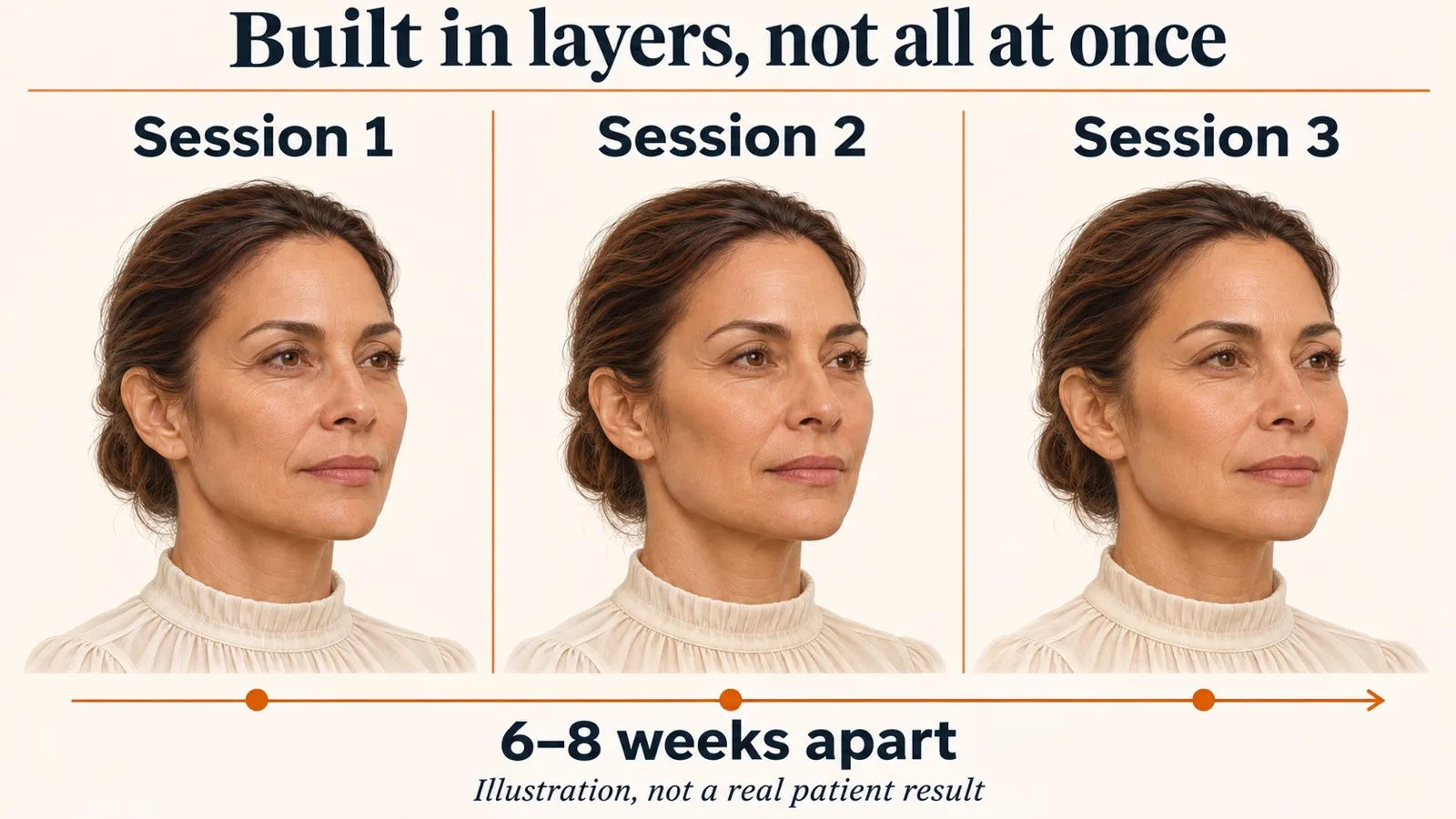
No. The collagen it builds becomes part of your own tissue. That’s why we build gradually, in layers, over several sessions.
Calcium hydroxylapatite particles in a firm gel. The gel gives immediate structure. As the gel is absorbed, the calcium particles stay; the body covers them, and that builds collagen and elastin.
Radiesse reconstituted with saline so it spreads out instead of staying in one place. At full strength it creates projection; spread thin, it restores volume over a wider area — the same job Sculptra does — for someone who has lost a lot of volume. It can also improve the skin, but placed very superficially it raises the risk of nodules, so we use it mainly deeper, to restore volume.
When you need structure or projection. Radiesse is firm, so it stays where it’s placed and can define — along the cheekbone, or in a line under the skin to shape a jawline. Sculptra is liquidy and better for broad fullness. For overall volume, both work by building collagen.
A long time. After the gel is absorbed, the fullness comes from the collagen and elastin your body builds, and that collagen takes many years to go away. People still change with age, so some maintenance helps — and yearly maintenance adds to your results rather than replacing them. Without it, those yearly changes would pile up.
No — it isn’t hyaluronic acid, so the dissolving enzyme doesn’t work on it. That’s one reason it isn’t placed superficially in the lips, in the thin lower-eyelid skin, or in larger amounts just under the skin.
It depends on your goal and how much volume you’ve lost. Definition: about 1–3 sessions. Hollowness after major fat loss: about 3–4 sessions. Ageing maintenance: about 1–2 vials a year, ongoing. We estimate the number of sessions and the amounts at the start.
At least 6–8 weeks apart — that’s the soonest. A large deficit is built in layers over a series, not all at once, because a big amount at once can cause lumps. Amounts can’t be predicted exactly, so Dr. Keswani may wait and reassess before the next session.
Gradually. In well-supplied areas, about three months; results keep improving for 3–12 months as collagen builds.
Yes — this is one of the three main reasons we use them. After major fat loss (from GLP-1s or other peptides, or after an illness), a defined course of about 3–4 sessions restores fullness in the temples, cheeks, the buccal area beside the mouth, the back of the jaw and the hollow beside the nose.
Pricing is personalized to your plan — text us at (201) 340-4809 for a quote in minutes, and see current offers on our Promotions page. Sculptra earns ASPIRE rewards and Radiesse earns Merz Xperience+ rewards.
Not really — it’s mildly uncomfortable rather than painful. Sculptra is prepared with lidocaine, and on the face we use a blunt cannula.
A needle cuts through tissue and small vessels, so it bruises more. A blunt cannula reduces bruising (not to zero) and is safer, because it doesn’t cut sizable vessels that product could block. Studies show entering a blood vessel is about 6 times less common with a cannula than with a needle.
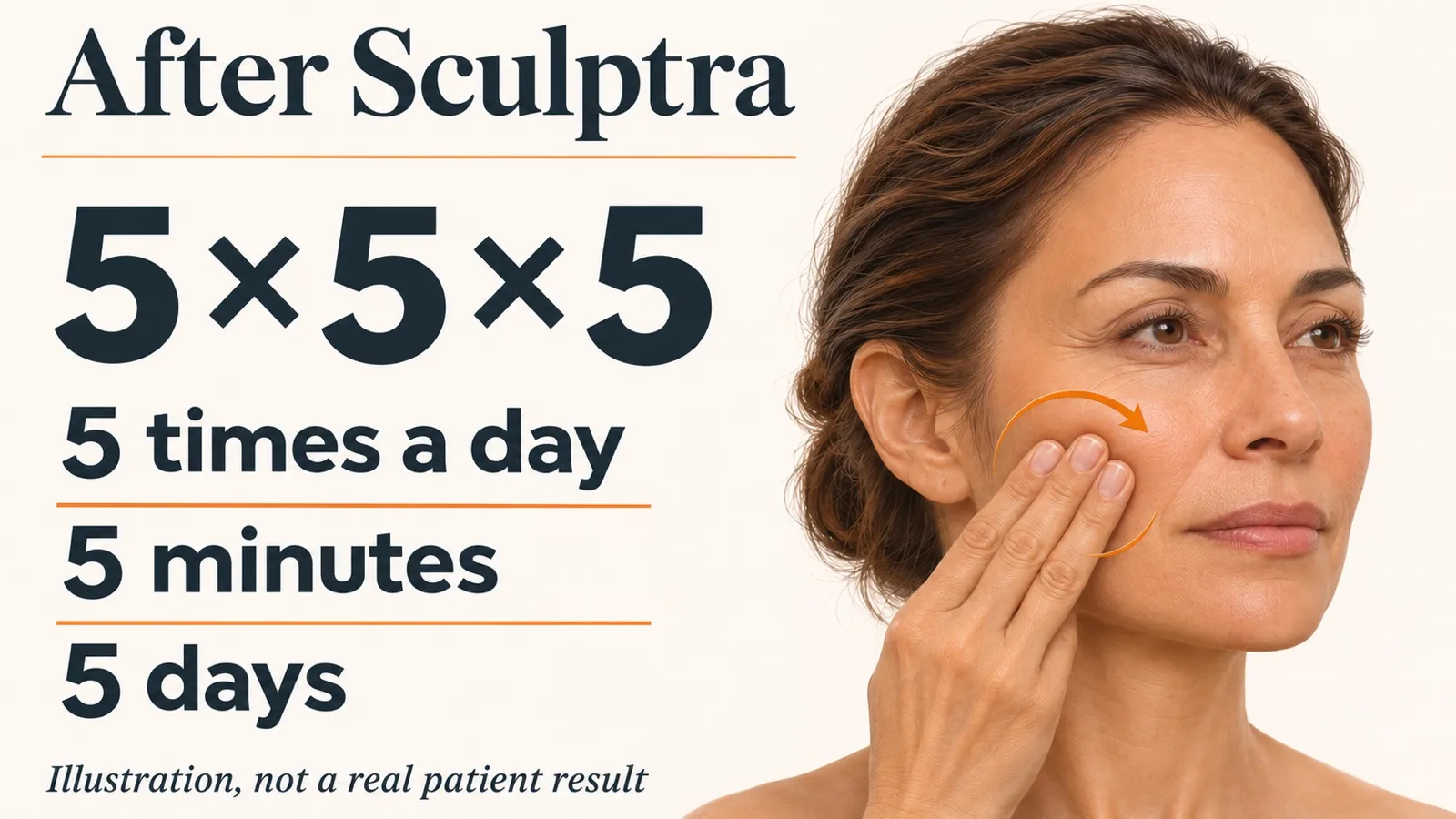
After Sculptra: massage the area 5 times a day, 5 minutes each time, for 5 days, with firm finger pressure to even it out. It’s one of the main ways we prevent lumps.
Both Sculptra and Radiesse can cause nodules, rarely. They form when too much product sits in a small area and collagen builds out of proportion there. We prevent them by preparing Sculptra days ahead with a good amount of liquid, spreading it rather than placing it in one spot, the 5-5-5 massage, and never placing larger amounts of Radiesse superficially under the skin. Rarely, a nodule can also come from a delayed immune reaction to the product, unrelated to the amount or depth; these generally improve with steroid injections. If a nodule does form, it can’t be dissolved like hyaluronic acid filler; it can sometimes be broken down with saline, or reduced with steroid or 5-fluorouracil injections — but it’s not an easy process.
It’s rare. Prevention comes from knowing the anatomy: going deep where vessels are superficial, staying superficial where vessels are deep, and avoiding areas where vessels have no clear path or are end arteries. Watch for these signs and call us right away: an area turning pale or blanched, or feeling cold; later signs are pain and mottled, bluish skin. Spotting it early prevents it from getting worse. If it happens, it needs urgent treatment to restore blood flow, sometimes in an emergency room, with ultrasound evaluation. Go to the emergency room right away for blurred or double vision, loss of vision, or stroke-like symptoms.
Before: avoiding aspirin and ibuprofen is advisable. A blood thinner prescribed by your physician for a condition is never stopped without checking with that physician first, because the condition could become serious. We don’t treat people on warfarin (Coumadin) or Lovenox; with recently started Plavix or high-dose aspirin, we wait, and if it can’t be stopped, expect more bruising. After: skip the gym and sauna for a day or two, preferably avoid alcohol, and keep the area clean — no pools or mud — for a couple of days.
Book Sculptra Book Radiesse Text (201) 340-4809
Treatment is individualized; your plan and pricing are confirmed with Dr. Keswani.


