
Lip filler is one of the most common treatments we do — and most people are happy with it. What they’re looking for is usually simple: a little plumpness. Lips that look hydrated rather than deflated, soft, with some volume. That can be created.
Lips are also personal. Some people want back the fullness that time has taken; others simply have smaller lips and would like more. Either is a valid choice — there is no fixed way a lip has to be, and we don’t judge. People ask us a lot of good questions about lips, so this page answers them: how lips are built, what filler does best, how it’s done, and how to care for your lips afterward.
At Forever Medspa every lip treatment is planned and injected by Dr. Deepak Keswani, MD, using hyaluronic acid fillers — a substance your body already makes, and reversible to a good extent if ever needed.
Book Lip Filler Text (201) 340-4809
The lip is an extension of the skin. The pink part — the vermilion — is skin without hair follicles, and its thickened edge is the vermilion border. Toward the mouth, the dry pink part meets a wet part, which is like the lining inside the mouth. In the middle of the upper lip sits the Cupid’s bow, the shape many people love; from its two peaks, ridges of thicker skin — the philtral columns — run up toward the nose, with the philtrum between them.
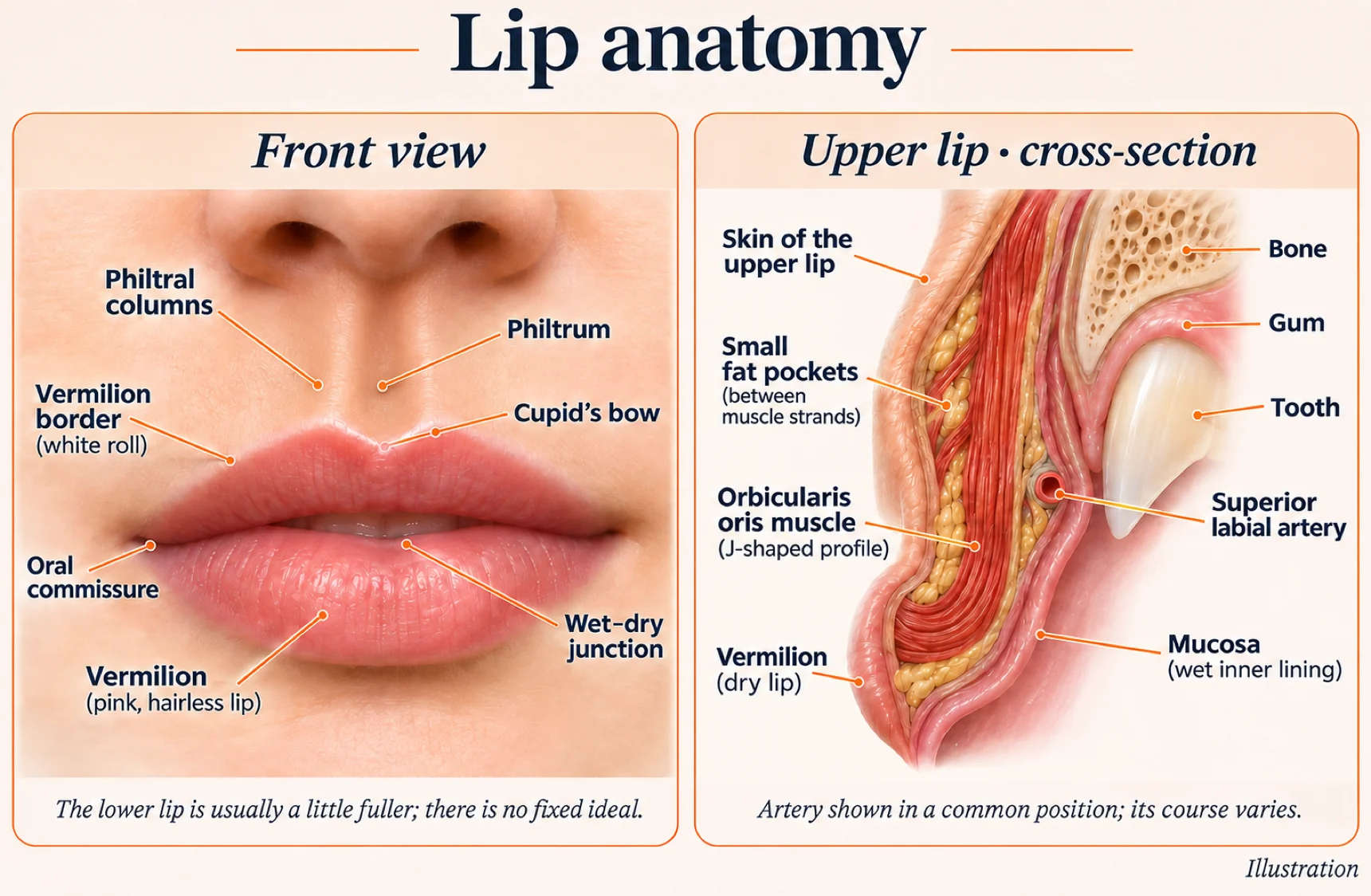
A simplified front view of the lips — a schematic drawing, not to scale.
Most of the time the lower lip is a little bigger than the upper lip, but there is a lot of variation.
Lips push forward, so more of the pink shows, because of two things: the support behind them — the skin from the nose to the lip, the gums and the bones — and the tone of the lip muscle, the orbicularis oris, which is shaped like a J; a stronger muscle turns the lip slightly inward. Lips are soft but still hold their shape, thanks to small fat pockets between the strands of that muscle. Those same fat pockets are also why lip lines form.
Not every reason is aging. Lips can be small for someone’s face without any aging at all, or someone may simply want more volume than they have. That’s a personal choice. And like any other part of the face, lips can be uneven — it’s just more noticeable, because they sit in the center, where one side is easy to compare with the other.
People come to us for their lips because of aging changes, sun damage, skin changes, asymmetry, size, or a wish for a certain shape. Most feel their lips have deflated: there are more lines in the lip, the lip is turning flat, and its shape is less prominent. That’s exactly where filler works well — a slight bulge, a slight roundness and fewer lines, with the filler staying in the lip where it belongs. That is what most people are looking for, and it’s why most people are happy with lip filler. Results disappoint only when a treatment pushes the edges. The key is simple: filler changes the size of the lips, not their shape.
What works — and why most people are happy
Pushing the edges — what filler can’t do well
Filler can also support mouth corners that bend down and build philtral columns temporarily — more on both below.
The shape of your lips — the dry pink part, its color and the length of the Cupid’s bow — is genetic and predetermined, and it can’t be changed except temporarily. Filler is placed in the fat part of the lip, not the muscle. Filler in the muscle can change the shape to a small extent, but it feels like something in the muscle and isn’t smooth, so it’s generally avoided. Trying to force a new shape risks lumpiness. The same goes for the Cupid’s bow: filler can’t create one that isn’t there, and adding extra filler to an existing Cupid’s bow actually weakens it, because it swells and stretches.
Every lip has its own capacity: the lip is a continuous space, and it can hold only a certain amount of volume. Lips that are very strongly structured can’t hold much, and the excess goes beyond the lip. In the lower lip that isn’t visible, because there is a lot of structure underneath. The upper lip is a dependent area: filler-related water collects there and slowly moves up, and if it goes high enough, the lip loses its shape. So if small lips keep getting more filler to make them bigger, they can only grow so far — beyond that, filler travels above the lip line.
Very soft lips can hold filler, but they need regular top-ups to keep the volume, or some deflation follows. That’s why over-inflating the lips, or stretching them too tight, is generally not recommended — unless you want bigger lips and your lips are soft enough to take it.
If one side is smaller, it can’t simply be made bigger. When more filler goes into one side, within a short time that fullness travels to the other side, and the two sides end up similar.
Lines in the lip often improve as filler gently stretches a deflated lip. Lines in the skin around the lip can be filled with thin fillers such as Juvéderm Ultra and Restylane Kysse — but that skin is very thin, so filler can show, and it isn’t the best solution on its own. A small amount of tox, or filler combined with tox, reduces the muscle action that keeps creasing the skin.
Mouth corners that turn down — from the muscle pulling down, and from sagging — can be treated with a small amount of filler placed just in the skin with a needle, which makes that spot stiffer so it doesn’t bend down. Philtral columns, if you don’t have well-defined ones, can be built temporarily with a very superficial injection in the skin.
When an older lip has become I-shaped rather than J-shaped, filler can’t recreate the J — that would take surgery, so it’s not an expectation to have. What filler can do is increase the lip’s volume.
Each filler is designed differently, and the right one depends on your lips — how dry they are, how much they tend to swell, and how much structure they need. There’s no single “best” lip filler.
| Filler | Character | How we use it in lips | Rewards |
|---|---|---|---|
| Juvéderm Ultra | Soft, hydrating | Dry lips; lines around the lips. FDA-approved for lips. | Allē |
| Juvéderm Ultra Plus | Soft, with a bit more structure; may swell and hold more water | Deeper volume loss in the lips (used off-label in lips) | Allē |
| Restylane Kysse | Soft and flexible | Lips that swell easily or are naturally full; lines around the lips. FDA-approved for lips. | ASPIRE |
| Revanesse Versa | Soft, smooth | Also used in lips | — |
Looking for cheeks, chin, jawline or smile lines? See our Dermal Fillers page.
Where the filler goes. Filler is placed in the fat part of the lip — the body of the lip — not the muscle. It can be placed in the vermilion border too, but that isn’t necessary: the filler stays where it’s placed, and there may be no real advantage to putting it there.
The lips have blood vessels, and a needle tip is generally smaller than those vessels. Knowing how the vessels run helps, but their course varies from person to person, so with a needle, filler can still enter a vessel. That is rare — the tip has to be inside a vessel at the very moment filler is released, and the probability is very low — and careful technique reduces the risk significantly, but never to zero. A telling sign: most people bruise after needle lip filler, because the needle breaks small vessels as it passes. With a cannula — a blunt, flexible tube — Dr. Keswani doesn’t see bruising in the lip itself (only, sometimes, where the cannula enters), which means far fewer vessels are broken.
1 · Two entry points
One at each corner of the mouth, serving both the top and the bottom lip.
2 · Corner to center and back
Filler goes exactly where it’s wanted; the cannula can go back and forth without adding the bruising risk of repeated needle passes.
3 · Needle with caution
For skin-level work, or when a cannula isn’t tolerated, a needle is used with a lot of caution.
How it feels. A cannula creates a different kind of sensation. Some people don’t tolerate it and need injectable numbing; if that isn’t tolerated either, a needle is the remaining choice, and it’s used with a lot of caution. For any filler, knowing the anatomy is a very important part of preventing complications.
We’re often asked about it. With a thin needle, filler is injected very superficially to create thin vertical columns in the lip, running at right angles to the vermilion border — from the border to the wet–dry junction. Making those columns takes many needle pokes, which causes a lot of bruising. Superficial filler can also become uneven: partly because placement is difficult and depends on experience, but also structurally, because the lip isn’t the same from one spot to the next. It can leave little lumps that look like patches in the lip. For these reasons, Dr. Keswani doesn’t suggest it and doesn’t use it.
Dose is dose. In Dr. Keswani’s experience, most people need at least one syringe (1 mL). It’s common to ask for half a syringe for a first treatment — but half a syringe isn’t a smaller version of the same dose (and if half, why not a quarter?). About 5% of people need two syringes, usually because their lips hold little water; only about 1% feel one syringe was a little too much for them.
Why the first days can mislead you. At first, swelling makes the lips look bigger than the filler actually is. Hyaluronic acid holds water, and lips hold a little more than most areas — but how much varies from person to person. If your lips hold little water, the change after the swelling settles can be small, and people may feel they went through the swelling and the discomfort without seeing much difference.
A second syringe, when it’s needed. The filler actually stays quite long — the small change is just hard to notice when you see yourself every day. For lips that hold little water, a second syringe about 1–2 months later, once the swelling has gone down, usually gives a fuller result that lasts much longer. On average, results last 9 months to a year, depending on how much water your lips hold; later maintenance is often about one syringe rather than two.
A typical lip filler timeline. Everyone is different.
Swelling. Any injury to the lips causes a lot of swelling, even without filler, and filler treatment does the same. Swelling peaks at about 2 days and then starts to go down; it can take 1 to 2 weeks to settle fully.
Pain and numbing. Lips are a little painful to treat. Topical numbing reduces the pain but doesn’t take it away completely. Injectable numbing — dental blocks around the lip — takes away the filler pain, but the numbing injection itself still hurts, and for some people that is worse than filler with topical numbing. In either case, there is some pain with lip filler; Dr. Keswani will help you choose.
Do you get cold sores? Tell Dr. Keswani about your history before treatment, and he will prescribe a preventive medication: take it on the day of treatment, or start it the day before, to reduce the chance of an outbreak. If a cold sore does develop around a lip filler treatment, it needs both an oral antibiotic and Valtrex (valacyclovir), which Dr. Keswani prescribes.
Call us right away at (201) 340-4809 if you notice severe pain, an unusually tender area, a pale, white, dusky or discolored patch, more visible engorged veins, a cold feeling in the skin, or pus-like spots. These are rare signs that a blood vessel may be blocked — treatable, and treatment works best when it starts early.
Lip filler is a very common treatment, and most people are happy with it. Fullness, swelling and bruising are the usual effects, and they settle with time.
Small lumps and bumps. Lumps can happen with any filler, but they’re a little more common in the lips: the lip muscle moves constantly and can trap a small amount of filler, which looks like a little bump. It’s not wrongdoing or a mistake by anybody — it’s how the area can behave. First, it can be massaged. If it doesn’t improve with massage, or it comes back, just that tiny part is dissolved, not the whole filler.
Other risks. As with filler anywhere, filler can — rarely — enter and block a blood vessel; the probability is very low, careful technique and anatomy knowledge reduce it further, and it is treated right away if it ever happens. Filler can also travel above the lip line when more is added than the lip can hold, which is why the amount matters. More in our Safety FAQs.
Hyaluronic acid filler is reversible to a good extent: an enzyme, hyaluronidase, breaks it down so your body can clear it. Whether it’s a tiny bump or a puffy spot, often only a small amount needs dissolving. Read more in our Filler Dissolving FAQs.
Medications. Tell us about everything you take. Aspirin and anti-inflammatories only mean holding pressure a little longer and a slightly higher chance of a bruise. Blood thinners that affect clotting — such as Coumadin, Lovenox, Eliquis and heparin — need a different plan, and any pause must be confirmed with the doctor who prescribed them. Details in our Safety FAQs.
Who can have lip filler. Adults only. We don’t treat with fillers during pregnancy; filler while breastfeeding is fine — just let us know.
Related treatments:Dermal FillersBotox & ToxFiller DissolvingFiller + Botox
Lips deserve their own page, but filler isn’t the only thing that helps them. Tox softens lip lines and the pull at the mouth corners. A lip flip with Botox shows more of the lip you already have, while filler actually makes lips bigger — the flip is an easy entry point, and the two can be combined. For lip lines in lighter skin types (skin types I–III only), fractional CO2 laser is an option. The Lutronic Ultra fractional laser treats sun damage and fine lip lines, including for medium and darker skin tones (skin types IV–VI). Morpheus8 (radiofrequency microneedling) tightens the skin of the upper lip and improves lip lines. Dr. Keswani can tell you at your consultation which of these fits your lips.
Related treatments:Botox & ToxLip flip (Botox)Fractional CO2 LaserLutronic UltraMorpheus8
Pricing is personalized to your plan — text (201) 340-4809 for a quote, and see current offers on our Promotions page.
More filler questions — general, safety, dissolving and filler + Botox — are answered on our Dermal Fillers page.
Not really — filler changes the size of the lips, not their shape. The shape of the pink part, its color and the length of the Cupid’s bow are genetic, and filler can change them only temporarily. Filler is placed in the fat part of the lip, not the muscle; filler in the muscle can change the shape a little, but it feels like something in the muscle and isn’t smooth, so it’s generally avoided. Filler also can’t create a Cupid’s bow that isn’t there, and trying to force a new shape risks lumpiness.
Lips can be uneven like any other part of the face — it’s just more noticeable because they sit in the center, where one side is easy to compare with the other. The smaller side can’t simply be made bigger: if more filler goes into one side, within a short time that fullness travels to the other side, and the two sides end up similar. So the goal is overall volume, with the two sides evening out.
It can, if more is added than the lip can hold. The lip is a continuous space with room for only a certain amount of volume. Extra filler in the lower lip isn’t visible because there’s a lot of structure underneath, but the upper lip is a dependent area: filler-related water collects there and slowly moves up, and the lip can lose its shape. That’s why Dr. Keswani doesn’t keep adding filler to make small lips bigger than they can hold. If filler has moved, it can usually be dissolved — see Filler Dissolving.
Partly. With age, the lip muscle’s J shape flattens toward a straight I, and the lip hangs and curls inward. Filler can’t recreate the J — that would take surgery, and it’s an expectation we’d rather you not have. What filler can do is increase volume, give a slight bulge and roundness, and soften the lines in the lip.
Lines in the lip itself often improve as filler gently stretches a deflated lip. Lines in the skin above the lip (radial lines) can be filled with thin fillers such as Juvéderm Ultra or Restylane Kysse, but that skin is very thin, so filler can show — it isn’t the best solution on its own. A small amount of tox, or filler combined with tox, reduces the muscle action that keeps creasing that skin.
Mouth corners can turn down when the muscle pulls them, and as the midface descends with age — which also adds to marionette lines. A small amount of filler placed just in the skin at the corner, with a needle, makes that spot stiffer so it doesn’t bend down. Marionette lines themselves are covered on our Dermal Fillers page.
Dr. Keswani prefers a cannula. The lips have blood vessels, and a needle tip is generally smaller than those vessels; knowing the anatomy helps, but vessels vary, so with a needle filler can still — very rarely — enter a vessel. Care reduces that risk significantly, but never to zero. Most people bruise after needle lip filler, while with a cannula he doesn’t see bruising in the lip itself, which means far fewer vessels are broken. A needle is still used, with great caution, for skin-level work such as the corners and philtral columns, or when a cannula isn’t tolerated.
No. In the Russian lip technique, a thin needle places filler very superficially in thin vertical columns that run at right angles to the lip border, from the vermilion border to the wet–dry junction. Making those columns takes many needle pokes, which causes a lot of bruising. Superficial filler can also turn out uneven — partly because placement is difficult and needs experience, but also because the lip’s own structure isn’t the same from one spot to the next — and it can leave little lumps that look like patches in the lip. Dr. Keswani doesn’t suggest it and doesn’t use it for those reasons.
Lips are a little painful to treat, and we offer numbing either way. Topical numbing cream reduces the pain but doesn’t take it away completely. Injectable numbing (dental blocks around the lip) takes away the filler pain, but the numbing injection itself hurts — for some people more than filler with topical numbing. In either case, expect some pain.
We don’t recommend it. Dose is dose: half a syringe isn’t a smaller version of the same treatment — and if half, why not a quarter? At first, swelling looks bigger than the actual filler, and once it settles, people whose lips don’t hold much water may feel they went through the swelling and the discomfort without seeing much change. For most people one syringe (1 mL) is the right amount. In Dr. Keswani’s experience, about 5% of people — usually those whose lips hold little water — need two syringes, and only about 1% feel one syringe was a little too much for them.
Usually, it hasn’t. Hyaluronic acid holds water, and how much your lips hold varies from person to person. If yours hold little water, the change after the swelling settles is small, and because you see yourself every day, it’s easy to feel it’s gone — but the filler stays quite long. A second syringe about 1–2 months later, once the swelling has gone down, usually gives a fuller and much longer-lasting result; later maintenance is often about one syringe.
On average, 9 months to a year. It varies with how much water your lips hold and how much gel is in the lip — once there’s enough, it lasts a good while, because the gel takes time to break down. Very soft lips can hold filler well but need regular top-ups to keep their volume.
There’s no single best — Dr. Keswani matches the filler to your lips at your consultation. Juvéderm Ultra is hydrating and suits dry lips; Restylane Kysse is soft and flexible, a good choice for lips that swell easily or are naturally full; Juvéderm Ultra Plus gives a bit more structure but may swell and hold more water. Revanesse Versa, a soft filler, is also used in lips. See the comparison table above.
Any injury to the lips causes a lot of swelling, and filler is no different. Swelling peaks at about 2 days and then starts to go down; it can take 1 to 2 weeks to settle fully. Cold compresses and keeping your head raised lower the peak, though the swelling resolves even without them.
Avoid kissing and using a straw while your lips feel tight. Lipstick can still be worn. Keep the area clean.
Workouts, yoga and similar activity can add to the swelling; if that’s causing you distress, stop. Ibuprofen (Motrin) can be taken afterward for the swelling, and cold compresses — 15 minutes on and off, as often as you can — help too.
Yes — just tell Dr. Keswani about your cold-sore history before treatment, and he will prescribe a preventive medication. Take it on the day of treatment, or start it the day before, to reduce the chance of an outbreak. If a cold sore does develop around a lip filler treatment, it needs both an oral antibiotic and Valtrex (valacyclovir), which Dr. Keswani prescribes.
Small lumps can happen with any filler, and they’re a little more common in the lips: the lip muscle moves constantly and can trap a small amount of filler, which then looks like a little bump. It’s not wrongdoing or a mistake by anybody — it’s how the area can behave. First, it can be massaged. If it doesn’t improve with massage, or it comes back, just that tiny part is dissolved, not the whole filler.
We don’t treat with fillers during pregnancy — we’re happy to plan your lip treatment for when you’re ready. Filler while breastfeeding is fine; just let us know at your consultation. Lip filler, like all our fillers, is for adults only.
Book Lip Filler Text (201) 340-4809
Treatment is individualized; your plan and pricing are confirmed with Dr. Keswani.


